Thursday, September 10, 2015

St. Vitus: The rope-dancer's patron saint


Rope dancers…have their patron saint, like other classes. St. Vitus is the object of their special invocation, and whoever has entered the walls of the cathedrals at Prague, bearing his saintly name, cannot have failed to see groups of poor and pretty girls, from various shows in the fair there, prostrated on their knees, praying no doubt for protection and aid in tumbling decently through life.
~From Blondin: His Life and Performances by G. Linnæs Banks


The spires of St. Vitus Cathedral, soaring up above the surrounding walls of Prague Castle, perched atop one of Prague's seven hills, are easily the most iconic landmark on the horizon here in Prague--Praha--The City of a Thousand Spires.


St. Vitus Cathedral is near and dear to my heart.  As I sit here, once again in the inner courtyards of Prague castle in the shadow of the cathedral, drinking in the present sights and sounds and savoring my new favorite historical tidbit, I'm also reminiscing.

When I entered the nave of St. Vitus Cathedral for the first time in 2006, I was, I'm afraid, dead on my feet. I'd arrived in the country earlier that morning and the brief sightseeing excursion was not only an introduction to the country where I would be serving as a missionary for the next fourteen months, but also a means of ensuring I stayed awake until bedtime in my new timezone. Even through the haze of exhaustion, I appreciated the austere beauty of this old cathedral, the miraculous innovations of Gothic architecture that allowed for the first time walls of stained glass and high, open spaces.


When I brought my parents to visit nearly two years later, they too fell in love with St. Vitus--so much so that we visited twice during our all too brief stay in Prague.  One of the best things I've learned from my parents--from my mother especially--is the habit of making time for just one more, "one last" look, and then savoring those moments to "make memories." In St. Vitus we did just that: lingering over the beautiful gospel art in paintings and stained glass, taking our time gazing up at the soaring vaulted stonework, meandering  along the aisles and transepts as tour groups were herded past us at a pace that we pitied. The memories we made in St. Vitus are collective favorites.

A few years later in grad school, I stayed a month in Prague for intensive language training. My dormitory was at the base of Prague's other fortified hill: Vyšehrad, and near the river Vltava, which divides the city, flowing first past Vyšehrad, then on and around the hill upon which St. Vitus rises. As I studied in my dorm room in the evenings, I could see the glow of sunset beginning. Leaving my books (and the inevitably Czech fairy tale playing in the background), I would rush out and down the street to the banks of the Vltava. From there I could watch the pinks of sunset light up the sky beyond Prague castle, and, as swans bobbed below me, in the glassy depths of the river beyond me, the reflected silhouette of St. Vitus danced in the ripples.


When I first started making memories at St. Vitus Cathedral, I had yet to embark on my journey of seeking balance and I had no idea that St. Vitus had been the patron saint of rope-dancers. That fun fact found me relatively recently: the same bibliophilic shopping spree last November and December that lead to my purchasing Tightrope Poppy and Girl on a Wire, which I've already blogged about, also lead to my acquiring Blondin: His Life and Performances, circa 1862.

You can imagine my delight when, just three pages into reading, I saw that familiar name of St. Vitus, in the quote used above. While the saints aren't part of my Christian worship personally, I love the history of them and like to be able to recognize them in artwork. At the time I didn't imagine that on my next visit I would feel a much deeper connection to that short quote, an increased kindship to this place and to the rope walkers of so long ago.

Amidst the bustle of tour groups and the chatter of a dozen different languages, I've found a spot for myself to sit and think and breathe. My body is still aching a bit from the falls and exertions of my second ever highlining experience at the Girl's Only Highline Festival VI. Just seven days ago I walked my first highline, an almost perfect first attempt. I achieved so much more than I expected, and with the bustle of travel, I haven't yet found the words I want to describe the experience or the amazing girls I met.

So I'm grateful for this moment of stillness.  In my head alongside the flood of old fond memories and the jostle of recent ones, I'm also imagining what St. Vitus Cathedral would have been like two or three hundred years ago, when those poor and pretty girls, the low, tight wire dancers of the traveling fairs, came here to pray to the patron saint of Bohemia, dancers, and entertainers. The progress I've achieved on this trip makes me want even more to learn to dance as well as walk, so that if ever a time machine comes my way, I'd be able to join them. 

And yes, even though I only have two days in Prague, I think I'll make time to come back here tomorrow for just one more look.

Friday, August 21, 2015

Semantic Exploration: Funambulist


“Funambulists”
Are “Well Balanced” People, who
Always walk the “Straight and Narrow”
And only get “High” on Wire!
~ Text of my favorite mug1


Funambulist (fyo͞oˈnambyələst/)

Yes, I am a word nerd. I love semantics, and this is a word worth savoring. Humor me. Let it roll around on your tongue:

Funambulist.

It’s a word I’ve used occasionally in posts, and even defined briefly in Learning the Ropes, but since it’s one of my favorite words I want us to take a minute and really explore it--take it apart, put it back together, and see what overtones it unwittingly carries.

It comes from two Latin base words: funis + ambulare2.

The Duquesne Incline funicular, Pittsburgh. Source: Wikipedia
Funis means rope3. You may recognize the root in the word funicular (especially if you've been to Pittsburg); it's basically a train/rail car pulled up an incline by a cable4. In anatomy a funiculus is a bundle of nerves5 and funisitis is an inflammation or infection of the umbilical cord6.

Ambulare means to walk7 It is the root of amble8 and ambulatory9, and while American parents prefer to take their infants for strolls in strollers, British parents perambulate10 with their offspring in perambulators11 (pram for short).  I must admit to having the phrase "agitated perambulation" stuck in my head for days after reading the book A Lady of Quality by my favorite author Georgette Heyer.

To return from my word exploration tangents: we put the two pieces together and, yes, a funambulist is a “rope-walker.”

Usually referring to tightrope walkers, it accurately applies to any rope walker across the spectrum of tensionings: tightrope, slackropes, and even the new kids on the block, the slackliners.

"Funambulism," or "rope-walking" really doesn’t evoke the same sort of compelling emotional response as do tightrope or highwire. That might not be such a bad thing: it is free of all those connotations that I complained about in A Hobby Hijacked.

The word instead takes a very different direction in most people's mental associations. Another word lover, to whom I am greatly indebted for many of the ideas in this post12, said it best: “…you can’t escape the sense of fun in funambulist – it’s such a strong taste right up front.”

I couldn’t agree more. Funambulists shed the focus on fear and focus instead on the fun. The fun of defying gravity, doing the seemingly impossible, and perfecting an art that is as old as the Latin from which the word is built. I certainly have a great deal of fun ambling along be it on webbing, rope, or wire.

Funambulist.  A fantastic word, full of Latin and full of fun.


1 "Tightrope Walker's Mug" by WordPress
2 "funambulist" from Dictionary.com
3 "funis" from Latin-Dictionary.org
4 "funicular" from Dictionary.com
5 "funiculus" from Dictionary.com
6 "funisitis" from mediLexicon
7 "ambulare" from Latin-Dictionary.org
8 "amble" from Dictionary.com
9 "ambulatory" from Dictionary.com
10 "perambulate" from Dictionary.com
11 "perambulator" from Dictionary.com (British dictionary definitions)
12 "Word Tasting Notes: funambulist" from Sesquitoica.
    Note: This post is, admittedly, incredibly similar to this one. I generally try not to reinvent the wheel, but I really love this word, so I hope I have something to add either in background or content to what has already been done.

Wednesday, July 22, 2015

Precious Moments, People Moments: Watch Me (Not) Juggle


Many of the brightest threads in my tapestry of memories are woven from the slender strands of human connection—simple yet precious moments of shared humanity: a genuine smile that reaches across to tug my lip into smiling in return, an inside joke that becomes increasingly hilarious only because we're both laughing, or simply recognizing in a stranger a kindred spirit.
~Me


My juggling has been progressing slowly since I wrote nine months ago. I’m still atrociously uncoordinated by most people’s standards, but the basic 3-ball cascade pattern is becoming more fluid. I’ve finally started work on two new tricks: overhand tosses, working toward the full “tennis” pattern, and columns.

Juggling pattern: Juggler's Tennis
Source: Library of Juggling
Juggling Pattern: Columns
Source: Library of Juggling


A few days ago I was working on columns. Unlike my carefully progressive drilling for the cascade pattern, this time I decided to skip any preparatory steps and just try it. Now, remember, it took me two years to learn the basic pattern: my hands know how to do one thing only. Not surprisingly this overly ambitious learning strategy was so out of sync with my abilities that I couldn’t manage to catch even the first two balls I tossed, let alone the one ball I threw up in between them.

On this particular day I had a little extra time, so I paused to practice. True to form I lost pretty much every ball I tossed, three balls and two hands all in a jumble. As I stooped to retrieve three rogue balls, obstinately ignoring the brilliant idea of simpler drills, I happened to glance up…and saw a college-age boy approaching me.

No juggler really likes to have people see them fumbling—I certainly would much rather awe people with my, admittedly, very minimal prowess. Part of the “grit” I'm learning through juggling is not being ashamed when people see my learning errors. So I shook off the tangles of insecurity and looked the boy square in the eyes...and was amused by what I saw. His expression seemed to be a subtle mixture of polite yet fascinated horror, incredulous pity, and subtle amusement, followed by a tinge of embarrassment that I’d caught his reaction.

I’ve never videotaped myself juggling really badly, but in that instant, as I tried to decipher the complex mix of emotions flickering behind the polite masking smile, I could imagine just how klutzy and uncoordinated I appeared. It also flashed across my mind that the guy might even think I was trying the regular cascade juggling pattern.

As he came even with me, I flashed him my sunniest smile, grinning in sympathetic agreement—and resumed my walk.


And yes, since then I’ve started working the preparatory skills for columns—simultaneously throwing two balls straight up, one from each hand; and alternately throwing and catching in the same hand. What I'm doing actually somewhat resembles the animated gif above, rather than just an incredible jumble of flying juggling bean bags.

Tuesday, July 14, 2015

The Wilds of "Varekai"


The word Varekai means "wherever" in Romany, the language of the gypsies, the universal wanderers. This production [of Cirque du Soleil’s Varekai] pays tribute to the nomadic soul, to the spirit and art of the circus tradition, and to the infinite passion of those whose quest takes them along the path that leads to Varekai.
~Cirque du Soleil


Rain was threatening as I hurried up the stairs to the arena for my first ever in-person taste of Cirque du Soleil. The weather didn’t matter, I was eager to bask in the glow of a live circus performance. Leslie, my best friend since middle school, hurried alongside me—yet another person who has been sucked into my obsession.

She had in tow a very enthusiastic walking encyclopedia of Cirque du Soleil facts. Thanks to the internet and my passion for research, I brought with me to my first performance a wealth of background information, trivia, and anticipation—all of which spilled into a running narration for the sake of my (luckily) interested friend.


Hey Leslie, did you read the show description already?  Varekai tells the story of the Greek mythology character Icarus—after he falls from the sky.

In mythology, Icarus was an over-confident youth who flew too close to the sun. Pride goes before the fall—in this case literally. His father, Daedalus, looked on in horror as the wings of wax and feathers he had made for his son disintegrated and the boy fell from the sky—presumably to his death. I object to unhappy endings, so I was very willing to let Cirque du Soleil rewrite this one.

After the pre-show clowning, the show picks up the thread of the tale where Daedalus ended it: with Icarus falling. Dressed all in white, Icarus fights his descent in artistic slow motion with graceful flailing of feet and waving of long feathered wings.

Source: Velveteen Mind

On the ground the unconscious youth is soon surrounded by the wary natives of Varekai. He regains consciousness to find that he has gone from the freedom of flight and the fright of falling to the imprisonment of a hoisted net.


Icarus is using the net like straps, cloud swing and aerial silk. Very cool combining so many different traditional circus skills in one act like that.


Source: Rodrigo Sologuren via Twitter
For me the show really got underway with “The Flight of Icarus.” Against the darkened backdrop of the primordial bamboo forests of Varekai, white-clad Icarus uses his captivity for an impressive range of aerial maneuvers: from contortion within the tangled weave of the net, to sitting and twirling around the net like a cloud swing, and finally, with the net hung only at one corner, wraps and big drops like aerial silk.

When Icarus is finally released from the net, it becomes evident that his fall has crippled him more than his aerial convolutions would suggest. He whose fable is considered a warning against hubris—excessive pride and self-confidence—has been thoroughly humbled by his fall.


“Cirque du Soleil is part of the “new” style of circus. It’s like if Ringling Brothers, Barnum and Bailey is the tap or ballroom of circus, then Cirque du Soleil is the modern dance.”

No traditional rings confine the acts of Varekai. Cirque Nouveau, or “contemporary” circus style, incorporates theatrical elements of staging, costuming, special musical scores, acting and dance. The loose storyline following the journey of Icarus is a hallmark of the style.

Two trademarks unique to Cirque du Soleil’s brand of contemporary circus are fantastical costumes and, even in a more limited traveling show like this one, innovative and expansive staging and rigging. Even set changes can be impressively innovative, often incorporated into the acts themselves.

The “Slippery Surface” contortion and acrobatics act was one of my favorites and easily highlights these two trademarks. Set in a sort of water world, a slick blue surface is stretched across the stage making it look like a pond. Clad in brightly colored, undulating scale-textured body suits, the performers slide and spin back and forth in contortions more reminiscent of aquatic invertebrates than solid-boned humans. When the slipping and sliding is done, a hole in the middle of the stage underneath the pond surface opens up and the character of Icarus falls down through it—taking the sliding surface with him as if down a swirling drain.

Photo by:Luna Markman, Source: G1.Globo.com

Some of the performers for the “Solo on Crutches” have actually had physical disabilities, one was a victim of childhood polio.

As in the slippery surface act, Icarus reappears through the acts, sometimes as a spectator passing along the sidelines, sometimes interacting with the (mostly) hostile natives, still crippled, at first only able to drag himself out of harm’s way. Of the whole show, it is that humbling that most tugged at my heartstrings. I was unsettled by the poignant figure of Icarus crawling and later limping, brokenly, through the magical new world he’d fallen into.

On his journey of healing, Icarus encounters a character who can teach the boy much about the art of (not) being crippled. Blending dance and acrobatics, the “Limping Angel” turns a symbol of hurt and brokenness into an art form and empowerment as he dances, glides, and spins on the crutches that have become additions to and replacements for his feet. Using his crutches, however, to trip and flip the still crippled boy didn’t strike me as particularly angelic.
 

“There are five…no six…different major circus disciplines and we’ve seen three of them already.”

Source: Canadian Tire Center
By the time the show is done, Varekai provides stellar examples of four of the six1 circus disciplines: acrobatics, clowning, aerials, and manipulation.

No matter the type of performance, Varekai is a riot of color. Tumblers dressed in yellow and red jump, twist and flip in perfect synchronization on an inflated mat that glows with each footfall. A duo aerial straps act sends warriors in black headdresses arcing out over the audience—then, somehow they meet again in the middle, creating mirrored, entwined figures, before flying apart once again. A juggler, green from head to toe, sets batons spinning through the air, manipulating the seemingly simple objects into gravity defying blurs. Two radically different sets of clowns provide colorful recurring comic relief from the more war-like creatures that inhabit the wilds of Varekai.


“Oooh…they just brought out double Russian swings, not just a single, this is about to get really impressive.”

Source: Snipview.com/
Not quite all the natives are hostile. As Icarus slowly regains the use of his legs, a character identified only as “The Betrothed” experiences a metamorphosis of her own—from the exotic yellow raptor-like creature who initially captures his interest to a white princess, his match and his equal.

After dizzying and colorful spectaculars, an erect and confident—though no longer arrogant—youth and his fully human girl glide onto the stage hand in hand. The celebration of their betrothal—and the finale of the show—is a Russian swing performance…a double Russian swing.

Russian swings are suspended with steel bars instead of ropes. The long swing platform can rotate 360 degrees and is long enough to accommodate two and even three standing acrobats. It is used to throw an acrobat high into the air and away from the swing—room for aerial flips, turns and twists.

For the landings, what had been two hanging projection screens are attached to the base of a 5-foot high platform, becoming the safety nets. The acrobats, launched off the front of their swing, land into the sheets or onto the platform…sometimes even onto the shoulders of partners standing on the platform.

In the finale of the already impressive finale, the two Russian swings are turned to face each other and the acrobats fly from one swing to land on the upturned edge of the other swing.

Source: MyBabyStuff.ca

Did you like it? Was it what you expected? Wasn’t it cool?

This was the first live circus performance I’ve been to in ages, and, speaking for myself, it did not disappoint. I have to admit, I attended more in the spirit of an aspiring student than a spectator, more as a technician than an artist. I was analyzing the movement, the rigging, and admiring the proficiency and technical perfection of the professional performers.

Besides the story of Icarus’s humbling and slow recovery, the title and theme of the show also struck a chord with me: I don’t really know where my passion for balance is taking me—it is certainly leading me to “varekai.” But “wherever” isn’t indicative of ambivalence or apathy; no matter what meandering path I pursue, I take my passion and sense of wonder with me.


Cirque du Soleil has a trailer for Varekai here if you’d like a glimpse of the show. And if you ever get a chance to go, I’d recommend it.


1 I would love to go more in depth into the topic of the circus disciplines, but that will have to wait for another day. For an excellent overview, please see Circus Arts 102 by Street Saint. Besides animal acts, which are often omitted in contemporary circus, the other discipline not included in the current version of Varekai is equilibristics—no balancing performances for me, unfortunately.

Sunday, June 14, 2015

Precious Moments, People Moments: Princess Slackline Dance Party


Many of the brightest threads in my tapestry of memories are woven from the slender strands of human connectionsimple yet precious moments of shared humanity: the sympathetic simplicity of seeing my heart reflected in someone else's eyes, a genuine, friendly smile that reaches across to tug my lip into smiling in return, an inside joke that becomes increasingly hilarious simply because we're both laughing, the reassuring joy of recognizing in a stranger a kindred spirit.
~Me


The day I met Mamo was an all-around fantastic day for making memories. The occasion was an extended family picnic at a local park. My four year old cousin, who, for the sake of anonymity, I will refer to as Cinderella—Ella for short—was the other child who made that day particularly memorable. As you can guess from the name I chose for her, she is princess kind of girl. She loves pink and looking pretty; she also gives the best hugs imaginable.

When I arrived, she excitedly ran danced and pranced on tip-toe to me for a hug. As she pressed her little cheek against mine caressingly, her mother approached. When I tended Ella and her brother a few months ago, at bedtimes I read them nearly every tightwire storybook I own. Ella’s mom let me know all those bedtime stories had an influence—the little girl in my arms had been teetering along the edge of their master bed at home. As she wobbled, she would call out, “Hey, Mom, look—this is what Guinevere does.” (Yes, I thoroughly enjoyed picking a secret princess codename for myself too.)

That was the perfect opening to ask my little friend if she’d like to try out a slackline herself—I “just happened” to have my slacklines in the trunk of my car. She chose the vibrant royal blue 1” Gibbon slackline over the glossy brown 2” line—having the most beautiful colored slackline is what really counts, naturally. Unfortunately I didn’t have pink.

Gripping my hands tightly, that little girl crossed that slackline more times than I can count, and every time she slapped her hand on the bark of the anchor tree, victoriously indicating another successful lap.

As I taught her about focusing on the anchor point rather than on her feet or the ground directly below, I mentioned that one of my favorite balance songs is “Don’t Look Down”—a song from the Disney series Austin and Ally. Well of course then I needed to pull out my phone and play the song. As she listened, her eyebrows puckered just a little bit as she concentrated with four year old seriousness. The song met with approval, as I’d guessed it would; when it was through she asked for it again. Pretty soon my phone was set to play it in a continuous loop; and even the slight pause in between repetitions set my Ella to worrying that the music had stopped.

The two of us took turns balancing, switching each time the song finished. When it was her turn, Ella would stand sideways on the line facing me, bouncing and swaying enthusiastically, belting out the chorus, “Don’t look down, down, down. Don’t look down, down, down, down.” Joining in, I did a shuffling imitation of dancing while keeping a firm grip on her.

When it was my turn to balance, I too would (try) to bounce in time with the music, frequently scrambling back on after my attempts at dancing instead sent me tumbling. And while I balanced, Ella twirled next to me clutching the phone in one little hand, holding it high so the music would play loud and clear.

She learned the lesson well—whenever another child came over and took a turn, she was quick to remind them, “Don’t look down! Don’t look down!” when there was even a hint of a glance earthward.

Her mother may not be thanking me for getting a song with an incredibly repetitive chorus so firmly fixed in her daughter’s head (though perhaps she could thank me for temporarily displacing “Let it Go”). The song is certainly even more firmly fixed in my memory now. I loved “Don’t Look Down” before—enough to blog about it after all—but now hearing it reminds me of that epic slackline dance party with one of my favorite princess girls.

Friday, May 29, 2015

The Heart Takes the First Step


Life has a habit of going around in circles, until you stand still and decide to follow the path that your heart is drawn to.
~ Leon Brown


With balancing being such a big part of my life, it isn't surprising that my emotional state is often a reflection of my physical balance. In this post I’d like to share about heart—what I've learned about the role of the heart in physical balance, how that connects to what I've experienced emotionally, and how important it is to follow the paths our hearts are drawn to.

First let’s talk a little bit about adjusting balance for funambulistic1 ventures. Along the narrow support of a rope, line, or rail, moving oneself forward is delicate operation: there isn’t room to shift from side to side as we normally do when walking. In the beginning, a balancer tends compensate for the frequent wobbling by throwing a leg out to counterbalance.  In this position the counterbalancing leg keeps the center of gravity over the wire, but actually has the upper body—and heart—significantly off to the side of the wire or line.

Here as I try to stay dry a counterbalancing leg is thrown out
and my heart is visibly off to the other side. My friends, who
experienced this while waterlining, termed it “starfish position.”
As the balancer progresses, he/she uses full “starfish” position less and less, but the tendency to shift from side to side can linger.

Rail walking; still in control and balanced but still kicking out a leg for
counterbalance (a moderate “starfish” position).
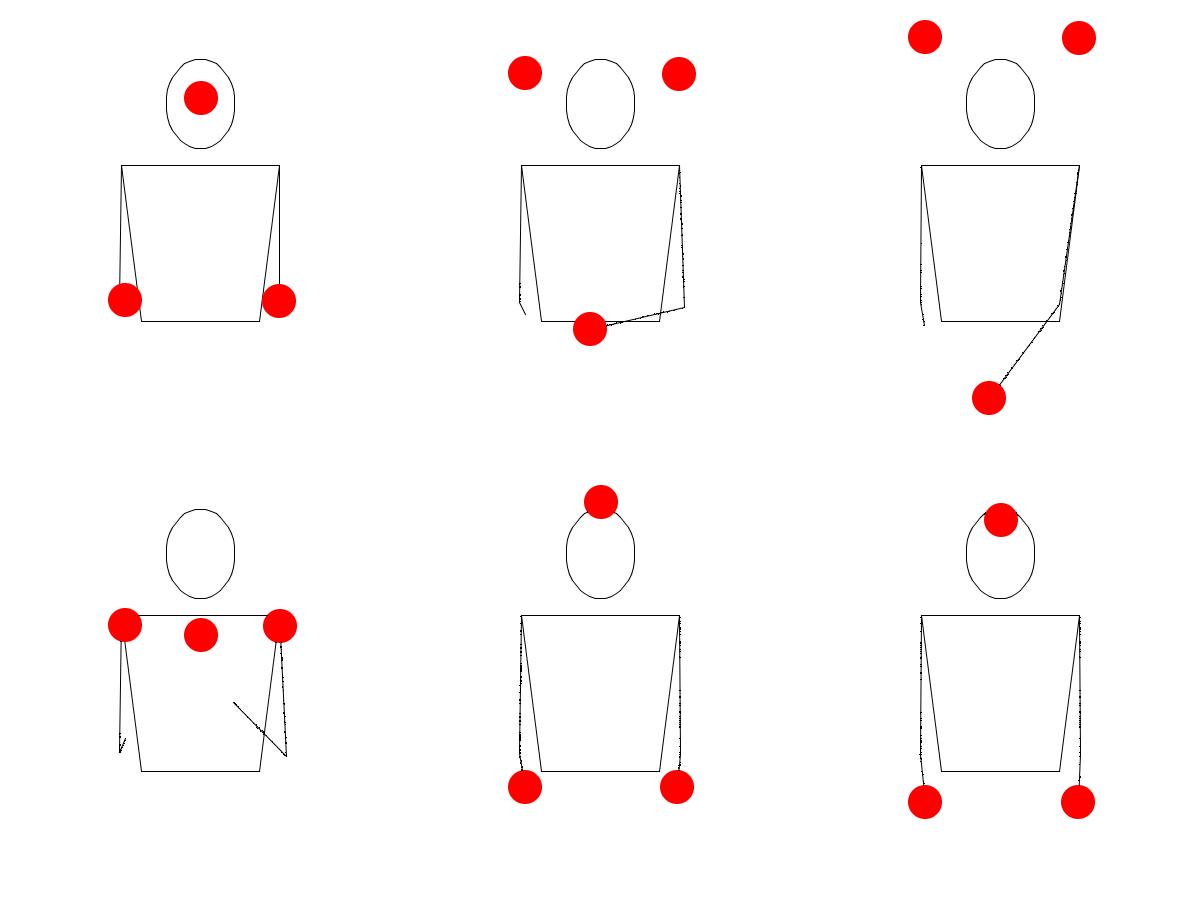
This is the stage I’ve been at: even when I've been walking fairly steadily, I find myself leaning a little to the right when I step onto my right foot and a little to my left when on my left foot. If you were to view my walk from above, tracing the path of my feet versus the path of my heart, the two lines would look something like this:


Now this kind of weaving and counterbalance footwork is inefficient at best. If too pronounced, it is downright dangerous: if a balancer on a highwire gets in that starfish position and the wire shakes or the wind gusts, he/she could very well falter just that fraction more and go toppling sideways, cartwheeling into the void.

Cartwheeling Starfish: A quick sketch a friend made while reviewing my post.
Thanks, Stacie P!
Since cartwheeling into voids is something to avoid, I’ve tried to stabilize my weaving. I drilled keeping my feet in line; I focused on posture; I trained my arms for continuous, subtle balance shifts. In spite of all that, I’ve still sensed myself weaving subtly from step to step, and I haven’t been sure how to stop it.

My heart had a hard time holding up under the frustration of this progress plateau.  As I’ve struggled for months to steady my weaving without success, my belief in myself and my ability to achieve my dreams has been weaving, wavering, and wobbling.

With sky-high dreams tugging so insistently at my heartstrings, it isn’t surprising that there is a good measure of heartache when I feel like my physical progress isn’t keeping pace toward my dreams. Ever since I read Mirette on the High Wire at seven years old, my feet—and my heart—have been unhappy on the ground. I dream of dancing in the sky. When I have practice session after practice session in which I fall off time and again without apparent progress, it can feel like my dreams might be cartwheeling into oblivion, soon to be dashed to bits against unforgiving realities.

And there are some daunting realities.

I’m already old for a full-time career in physical performance—most elites performers are peaking or winding down in their careers at this age, not beginning, and yet I aspire to approach that level of athleticism and skill.  I’m frequently and painfully aware of how unathletic my childhood was—and twinges of jealousy and insecurity claw their way up past my heart when I’m around “real” athletes. And even though hard work now can make up for some of that, without a circus center nearby, the training I do for the time being is solo and improvised, which often leaves me feeling directionless in my training and, worse, aching for a sense of community and belonging. Also, given my beginner (possibly intermediate) status, the idiom “don’t give up your day job” seems relevant, but I’m struggling to scrape together time for serious solo training while holding down that professional job. Plenty of evenings when I get home I want to fall into bed rather than hop up on my balance pipe for even the 5 minutes of balancing I committed to as part of my winter solstice resolutions.

Besides the discouragement of those daunting realities, I’m also very sensitive to what other people say or (may) think. When I think people doubt my ability to succeed, I worry they might be right. The  risk and irresponsibility of dangerous high balancing can make people frown with disapproval and genuine concern…and I've usually been proud to be “the responsible one.” Even this blog sometimes adds to the pressure: though I love you readers, it’s intimidating that there are even more people who will notice if my dreams never amount to anything.

The dreams of conquering a highwire or a highline, of having the skill and finesse to perform on a slackrope or tightwire take a thick skin, time, passion, and life. On the hard days that investment and sacrifice seems inconvenient and impractical at best, impossible and irresponsible at worst.

In spite of all the hard days, the doubting days, there are the days and even mere moments that completely make up for it. Times when I’m reminded that I am at my best—focused, passionate, and laughingly enthusiastic—when I’m pursuing what I love, when I’m balancing. In those moments I stop worrying over slow progress, over what others think. Everything fades away except the beautiful feeling of being balanced. Recently a breakthrough in overcoming my weaving created one of those deeply fulfilling moments.

My mental strategy for overcoming weaving came, interestingly enough, from my favorite Regency era romance novelist, Georgette Heyer. A phrase she uses in several stories is how skilled horseback riders take jumps by ‘throwing their hearts over’—a vividly appealing imagery of daring and confidence. Approaching the stile, hedge or ditch, the rider isn’t hanging back but leaning forward, anticipating, positioning himself or herself to complete the jump successfully.

Though a far cry from equestrian riding, I decided to apply the focus on heart to my balancing. With each step I would visualize moving my heart straight forward so it would be directly over my next foot when I stepped. Projecting farther ahead through multiple steps, my heart should trace a straight line, remaining constantly within a narrow invisible channel parallel to and above the straight line of my balance pipe or line.


The results of that visualization were incredible. In the limited confines of my kitchen, with the dinner table against the wall to accommodate ten feet of practice pipe, I was moving steadily and smoothly forward, all the while keeping my heart inside of that invisible path I had created in my mind’s eye. I wasn’t weaving or wobbling; I was more balanced and steady than I’d ever been before.

That feeling of being almost perfectly balanced was a straight and steady joy. As that joy bubbled up, flowing around and over my solid sense of focus, something shifted. In my imagination I projected that perfect line of my heart much further than the confines of the room. I felt sure that if I could just keep walking like that, keeping my heart inside that perfectly straight channel, I might be able to step off the end of my pipe and onto a slender strand of a dream, walk straight through the wall and into the phantasmic white and silver circus tent beckoning shimmeringly just a few perfect steps farther in the distance.

Though at the end of my practice pipe I halted, reluctantly remaining within the confines of reality, that ethereal waking dream left me a gift—a profound confidence that if I can walk like that, anything is possible.

While the weaving of my heart and feet was a specific source of discouragement, carefully following an invisible heart-path became a source of success and deep fulfillment. I believe there is a truth to be found in my experience: following the paths our hearts are drawn to keeps us steadier, protects our confidence and our passion, and positions us for a successful arrival in the realm of our dreams.


1 If you're having trouble with this word, please review my post Learning the Ropes.

Sunday, May 3, 2015

Yoga: Balancing Strength and Softness


Life is a balance of holding on and letting go.


For the winter and spring months, especially while my regular balance training was somewhat inhibited by the weather, I tried a new cross-training sport: yoga, a discipline centered around awareness and balance—perfect. After four months, I’m still easing into it, learning terms and poses, and becoming comfortable with the mentality, but it’s been good for me. I’m sad that the last practice was this week, but hopefully Hulu’s multiple free yoga channels will get me through the summer.

Something my instructor Emily focuses on that resonated with me is balancing the opposites of strength and softness, ease and intensity. My body is incredibly reluctant to go into some of the more challenging poses…and some days “challenging” means just about anything besides mountain pose (standing upright on two feet) or corpse pose (lying flat on my back). I started out with the assumption that advanced yogis just slid into the poses easily and when I couldn’t, I just needed to keep pushing myself down into the pose until it became easy and elastic.

At first when my instructor told us to find areas to relax in the midst of the poses, I was incredulous. Nevertheless I followed directions, and was surprised how, even with my body twisted into somewhat uncomfortable pretzel shapes, I could still carve out spaces for ease: a softening behind my heart, around my eyes, or along my throat.

I was also amazed how often Emily instructed us to engage muscles—and the exact opposite of the muscles I was using to force myself into the shape of the pose. I learned that this engagement of opposing muscles creates a sense of support so the body won’t fight the pose. Strength is actually a key component in softening.

When it comes to my personal preferences for ease versus intensity and strength versus softness, I learned within my first hour of yoga that I am far more comfortable with strength and intensity than with ease. That first day of class I honestly felt somewhat cheated when I realized that for the last 5 or more minutes of class we were going to lay down on our mats and close our eyes (like it was pre-school nap time!). I’d dedicated 40% of my sacred hour-long lunch breaks to a fitness class: nap time is not a workout. Worse than that, lying there trying to relax and quiet my thoughts left me not just restless but unsettled.

Since I was certain that the relaxation of shavasana meditation shouldn’t be emotionally threatening, I tried to figure out what was going on. As best as I can articulate it, the meditation brought to the surface a nagging fear that allowing myself to unwind would devolve into an emotional unraveling. I’ve been holding on to stress believing that holding everything in is holding me together. In much the same way I initially tried to force myself into the poses, I was attempting to force myself into relaxation—while holding onto tension in ways that prevented me from achieving anything more than a superficial relaxation.

Even after four months of yoga, I’ll admit I haven’t yet learned to relax enough to risk that unraveling, but I recognize my resistance to it. In class Emily often instructed us, when we felt physical discomfort or resistance, to “honor that resistance” or to “sit with it” for a few moments before moving more deeply into a pose. I’ve had to do that with my resistance to relaxation. I notice it and acknowledge that there must be reasons for it I don’t really understand, but I can let it be—and simply accepting where I’m at in my life. Aknowledging the resistance seems to loosen its hold on me.

Shavasana is now a welcomed end to a yoga practice. I’ve learned to appreciate the rewards of quieting the incessant internal dialogue that dominates my mental processes and the simple restful quiet of corpse pose—and I’ve only fallen asleep once so far. I’m also learning to use my strength to create a sense of stability as I patiently work with my body rather than forcing it.

These yoga lessons have already translated into improved balance training. Even though my thoughts are quietest on a rope, even there my internal dialogues still intrude. I’m more aware of the chatter now and then refocus on the purity and simplicity of me and my rope. And even in the midst of the strict and controlled posture of rope balancing, I have also found spaces for relaxation—my eyes, my throat, and especially my shoulders and upper arms so they flow through the constant counterbalancing.

The incredible thing about balance is that it can take two things that should clash—after all the root of "opposite" is the verb “to oppose”  which means “to compete”—and lets them work together. Strength and softness, ease and intensity. Allowing opposites to work together in our lives is transformative, creating peace where there was contention. And so ending with “namaste” seems incredibly appropriate.

Namaste.