Wednesday, June 29, 2016

Dixie Willson—Where the World Folds Up At Night


I had faced down those dreams and intended to forget them … But sometimes there are things you are willing to forget, which, nevertheless, will not be forgotten! And after a little while I had begun to find that my dreams were more real to me than life.
~Where the World Folds Up at Night, Dixie Willson, 1932, p. 23


Just twenty pages into Dixie Willson’s circus memoire, I was very certain that I was going to like this endearingly ardent Midwest debutante turned circus performer turned novelist. The feeling only deepened as I became acquainted with, if only through yellowed and musty pages, a kindred spirit who also had dreams that would not be forgotten.

It was while researching Bird Millman, that the archive librarian in Colorado sent me excerpts of Where the World Folds Up at Night. Reading what Dixie Willson had written about her dear, dancing highwire friend, I grew as interested in the author as her subject—an author whose career in children and young adult literature took off during her time with the circus.

Dixie Willson today is not nearly as famous as I think she deserves to be, so her books can be hard to come by. Luckily there were a few libraries around the country willing to loan me their nearly hundred-year-old volumes. Soon I had in my possession creaky, canvas-bound tomes, their uneven pages feather-soft from countless thumbings, their tattered library card stamps detailing four generations of reading.

The novels Little Texas and A Mystery in Spangles were light, happy circophile fiction. Having to return Where the World Folds Up at Night though was so heart-wrenching that I eventually found and purchased my own antique copy—one that, I found out later, had been retired from Dixie Willson’s hometown library.


If you’re not particularly interested in the golden era of train-traveling circuses, I’ll warn you now that this is my longest blog post to date, so you may wish to skim or skip to the end. But if you want to feed the fantasy of running away to join the circus, I would like to share the highlights of Dixie’s memoire. She didn’t write of the well publicized tragedies and triumphs in the ring, but rather of the scenes and scenery behind the curtains and beyond the show tent, the unique microcosm, which each night packed up and traveled on—because, in her own words,
In this story of the glamorous unreal (yet so real) little world, I have wanted to tell the things you do not know. … My hope is to bring you a sense of just nomadic, happy circus days and nights, sunny mornings, busy afternoons, gentle twilights. (p. 62)
Dixie Willson came from a respectable, well-to-do Midwestern family. While other girls her age were settling into marriages, she joined the first wave rebellion of the Roaring Twenties, and pursued her childhood dream to “join out” with the circus. Serendipity landed her an interview with Charles Ringling—Mr. Charlie—himself. With a little persuasion, he agreed to grant her citizenship in the backstage world of the 1921 Ringling Brothers, Barnum and Bailey Great Combined Shows.
And so I came to the circus back door, a kaleidoscope, it seemed, of a thousand sectors! Tents of every shape and size; a troupe in pink tights and jeweled collars; a boy toreador with a dozen yapping poodles on scarlet leashes; … the Queen of Egypt wrapped in gold veils swaying solemnly by on a camel; floats glaring under the white sun; working men bringing, taking, moving, shifting, meaningless pedestals and hoops and wheels and baskets. (p.12)
If Dixie’s first impressions of circus life resembled a kaleidoscope, so too does her narrative as she flashes from one scene to the next. While it begins as she joins out and ends on the last day of the season, through the middle I frequently lost track entirely of the route her pleasant memory meanderings had taken. In deference to modern readers’ desire for (relative!) brevity and linear narratives, I’ll try to put together a few highlights following Dixie through her typical circus day.

A circus performer’s day began waking up in curtained bunks, the train still barreling along. After a turn in the washroom, as the train pulled in, it was time to disembark and trek to the showgrounds, or “lot” as it was called.

Naturally, food was next on the morning priority list. Breakfast, lunch and dinner were served in the cookhouse, whenever the white flag with “Hotel” written in blue was flying. Waiters were attired in white coats, ready to pass inspection by the most fastidious of maître des. Gentlemen were required to wear coats, ladies required to wear better than everyday housedresses. (p. 16-17) The food and etiquette remained constant as the scenery accompanying the meal constantly changed:
Sometimes your feet are on baked yellow dust, sometimes on a carpet of wild violets; sometimes you are wearing rubber boots and a slicker, the table in a puddle halfway to your knees. But it is all the same. The mint sauce comes up just as properly with the lamb, the potatoes are just as brown, and everybody just as happy. (p. 56)
"Twenty-Four Hour Men" had already come through the day before to plaster the town with fliers.  Still, one of the first orders of business for the circus was to even more thoroughly announce its arrival. The morning main street parades were extensive: riders on horses, decorated carriages, wagons with wild animals. Crowds lined the streets waving and cheering, but like the most stoic imperial guards and proper British footmen, the performers kept resolutely in character, knowing they would be fined for looking at anyone in the crowd as they passed. (p. 44).

As a new performer with no specific skill set, Dixie was hired to be one of the hundreds of “bit” performers. In parade she made up the ranks of the red, white, and blue section of cavalry. Luckily her horse knew well enough what to do, because Dixie had never actually ridden before. Later, when another performer broke her arm, Dixie would take a turn as Cleopatra in a golden wagon drawn by eight camels, reclining on pillows and singing and playing popular tunes on an electric piano keyboard built into the golden floor (p. 89). Twice she also had the honor of leading the parade alongside the equestrian director.
My most vivid memory of Chicago is parade, as I saw it there. …again I remounted the blue-eyed horse…ahead of the first section. … Since I was first, I was first to break line and cross the bridge [onto the island and into Grant Park where the circus sat on the banks of Lake Michigan]. But instead of going on to the pad-room, I stopped and looked back. And saw, coming down two miles of that avenue, two miles of parade. … A two-mile ribbon of a thousand colors! (p. 125-126)
Preparation before and downtime between parade, matinee, and evening show would be spent on the “back lot”—the showground behind the public areas. With the sleeper cars on some distant switchyard during the day, the dressing room contained a performers’ small square of personal real estate: two buckets of water, a chair, and a trunk.
A hybrid combination, the ladies’ dressing room of the fantastic and the domestic. Side walls fluttering with bright, light sparkling skirts and gay, iridescent bodices; … and in the shadow of this, the busy laundry buckets, the ironing, the baby tending; a lady in calico and kid curlers solemnly fitting a Sunday silk; … someone resplendent in the flags of all nations busy getting buttons sewed on their husband’s shirt and exchanging apple pie recipes with somebody else standing in a bath bucket clothed in soap suds. (p. 38)
Like the cookhouse, the backdrop of the dressing tent and back lot was ever changing.
At the lot maybe you will find cowslips growing by your trunk, a brook babbling behind the padroom. Maybe your day is spent among the seared weeds of a vacant square in a city, your trunk balancing uncertainly across the broken cement blocks and cinders of some discarded sidewalk. Perhaps dressing-tent and big top are crowded against a row of bungalow porches, or maybe you find yourself in some whispering, surprised little grove, protesting acorns tapping all day on the roof. (p. 84)
Both the matinee and evening performances under the big top began with “spec”—the grand opening spectacle or “entry” parade—that circled the big top. For this, Dixie dressed as harem girl in yellow satin trousers and jeweled veils and rode in a howdah on an elephant named Fanny. Interestingly enough, Fanny had a lot to do with Dixie’s literary success.
I looked for a place I could be quite alone—and found it in the howdah of my elephant, when I mounted early for tournament. … Always afterward when any one would speak of this story or that one of mine which they had read somewhere…I would smile to myself and feel again the hard little wooden seat of that rocking, shifting howdah, a blistering sun beating down upon my spangle-dressed back; … [Writing a climactic scene in the story] would be interrupted by the equestrian director’s whistle, the back door would fling open, the band would begin, and I would put my paper and pencil on the floor, arrange my hands along the gold lotus lilies carved along the sides of my howdah, and we would swing into the big top, my feet carefully on the story so as not to lose the sheets of it. [p. 49-50]
Those climactic scenes she so jealously guarded with a satin-slippered foot were not about the circus at all. Though Dixie wanted desperately “to capture the heart throbs, the humor, the fantasy, the nobility, and most of all the simplicity,” of life in the circus, while she was living in the midst of that “riotous bazaar,” it was “too vibrant, too pulsating, too brilliant” to capture in words (p. 48-49). So she wrote instead stories of Russia peasant girls and pants-wearing puppies named Pinky…and she got them published.

Dixie had no complaints when Charles Ringling had asked if she would be willing to parade on horses and elephants. Surrounded by some of the best acrobats and performers of the 20th century, Dixie was soon ambitious to be more than another body in the grand spectacles.
I was feverishly eager to be part of everything. I wanted to swing from the highest trapeze. I wanted to enter the cage of the fiercest lion. I wanted to try my mettle and measure my grit with the rest. I wanted to fit into a place where that steady fearlessness and never-failing courage would be required of me too. If a disregard, a contempt, for the white feather were the only thing the circus has taught me, I should consider it, for that alone, a magnificent association. (p. 99)
Dixie wasn’t the only bit performer that season ambitious to learn. For the next season’s opening act, Mr. Charlie wanted the ceiling of the big top decorated as a human chandelier, filled with dainty, dangling, sparkling iron jaw performers—and he had offered a salary bonus. Many of the women who had bit parts so they could accompany their husbands began training to hang by their teeth from the top of the tent. During the afternoon practice time in between shows, in the deserted big top there would be groups of men who, after having hoisted their pretty wives up “three or four or ten or twenty feet” off the ground and set the rigging ropes swaying, would sit lounging, smoking cigarettes and chatting, keeping one eye trained on their wives, waiting for the signal to lower them back to the ground. (p. 106-108)

Dixie did not join the afternoon iron-jaw epidemic. Her restless ambition found an outlet when the “boss elephant man” took her aside to try her out “working the bulls.” For three weeks she learned “style” and handling, while the elephants, keen to return to where eager children fed them peanuts, hurried through their routines.
[A]t last, one day, the girls crowded around the back door to watch me go in, riding the rocky valley of Java's head with all the dash my shaking legs and arms could muster! In eleven minutes it was over, and I was back in the dressing room, hot and cold… Without disaster and in fact with a certain appearance of ease, I had presented an act of trained elephants … I had thrilled to the flash of my spangles in the light, to the feel of that spongy sawdust under my new yellow boots; I had felt a consuming pride in riding a saluting exit, swinging in the crook of Java's up-raised trunk; but best of all was the steadily rising lump on my head—the gentle side-swipe I had received … as [Java] had given me a subtle reminder with the natural baseball which finishes every elephant's tail, that I was at one end of him when I was expected at the other! (p. 100-101)


After the last show of the day came the trek from the lot back to the railyard. The cars had been moved since morning, so flares were set up along the way to guide performers to their section.
Across the stretch of dark, others were coming “home” too, shadowy figures in two’s and three’s. Nothing dramatic, nothing spectacular; just people quietly coming home. Yet it set my heart racing. The very lack of drama in a thing so fantastic was drama. The simple thing of those people crossing that border of dark from the lot to the show train; murmur of voices; chairs gathered around outside the cars; panels of pale light under the windows. (76)
Train porters had come through while the performers were away. After dusting and tidying, they tied back the aisle curtains, so the performers returned to sun warmed and aired sleeping quarters each night. Dixie loved her four feet by six of Car 91.
I found I could forget everybody in the car, when I chose, and pile up my pillows, close the dark green curtains between myself and the aisle, and read or write or sew, the train traveling maybe, standing along a country lane maybe, or maybe in the bustling railroad station of a city, which last was always a little exciting. It always gave me a delightful superior feeling to look out of my rose-colored nest at travelers hurrying on and off trains… (p. 81)
And while she lounged or slept in her bunk, the train rumbled on. The travel was simply part of life.
Perhaps [people] think it is hard to move from one hundred to three hundred miles every day. But of moving, except the changing interest, you are not even conscious. Both in the cars and at the lot everything is quite the same in Illinois in the morning as you left it in Indiana the night before; exactly the same in little Chico, California, in September as it was in New York City in March! … It would, of course, be a luckless life for those who cannot sleep on a train. The circus performer’s difficulty along that line comes on Sunday, when we have already arrived in Monday’s town, and most of the night is spent in a vain effort to sleep without that motion, that singing hum of traveling wheels which come to be a lullaby. (p. 82)
And so ended a circus day as it had begun: with the lullaby of train on track.


Throughout the book, what struck me most was how Dixie reveled in and vividly captured the picturesque in everyday circus life. Not every inhabitant of the traveling cavalcade saw life as Dixie did. Even Mr. Charlie Ringling, who “loved so many simple things which men of less conspicuous success pass by” (p. 9), at times saw a life of “[h]ot, dusty working days and mud holes and railroad tracks” (p. 195). In Dixie’s reply to Mr. Charlie and his to her, we find the real gift of her book:
I shall never forget Mr. Charlie’s answer that day, when I told him how little I had been aware of heat or dust or mud or cinder tracks. He looked at me a long minute and gradually over his face came a little smile. “The only measure a man can have for life is the size of the windows through which he looks at it. I am sorry to think I have been caught looking through little windows”. (p. 195-196)

From Dixie I was reminded of the powerful everyday magic radiating from simply loving life.
May we remember to look at the world through wide windows.

Thursday, February 11, 2016

Snow Day


“When there’s snow on the ground, I like to pretend I’m walking on clouds.”
~ Unknown


There is a serene, hushed beauty in the winter expanses of pure, undisturbed snow. While forging through such snow, then turning back to admire the winter path I’ve created has it’s appeal, I often feel a little bit sad that never again and for no one else will it lie perfectly like it did before I left my footsteps—at least until the next storm. This past weekend I tried something a little different: walking above an expanse of undisturbed snow, doing my best to keep it pristine, so that it looked like I was hardly there at all.

Last month I posted that I’ve been striving to embrace the season more. According to a quite talented, but sadly unidentified epigrammatist, “To appreciate the beauty of a snow flake, it is necessary to stand out in the cold.“ Well, last Saturday the snow was deep, the day was a lovely mid-winter warm (33 degrees), the sun was shining through hazy skies, and my slackline withdrawal had reached unacceptable levels, so I decided to risk face-planting in the wet white and set up my slackline.


The cold necessitated some extra preparation and gear: a pair of Zemgear minimalist slippers and a white Tyvek ground cloth for a changing and staging area.

Of course, the photographer in me wanted a photo op, and I had to get creative to find angles and shots in the snow. I got really adept at finding unusual locations for my flexi-mini tripod, setting the time delay on my camera, clomping along at a gallop in my winter boots (made overlarge by the lack of thick socks), kicking off said oversized boots at the edge of my ground cloth, hopping into my slippers, and clambering up onto the line in time for my selfies. Once my camera had done its work, I’d cross a few more times till I was tired, hop down onto the tarp, slide back into my boots, and check to see if any of my shots had turned out. Reposition, reset, and repeat. Yes, yes, obsessed photographer. That’s me.


All in all, the snowline was a lot of fun. Being outside in the sunshine and crisp breezes was delightful. Like the waterline, the presence of snow (and my desire to stay out of it) added a level of mental challenge that I had not anticipated. Though my first several Chongo mounts were aborted, I found my rhythm in spite of wobbles and only fell off once—no face plant, just straight up to my knees after a shaky mount.


Other than the trails at the edges for setup and the ground cloth area for mounts and dismounts, (and those two leg holes), I managed to keep the snow around the middle of the line pristine and unbroken.


Rope walking often allows me to feel like I'm walking through the sky, and certainly adding a sleek blanket of deep snow added to the illusion of walking on the clouds.


Sunday, January 17, 2016

The Winter Off-Season: Dreaming in the Dark


“We grow great by dreams. All big men are dreamers. They see things in the soft haze of a spring day or in the red fire of a long winter's evening. Some of us let these dreams die, but others nourish and protect them; nurse them through bad days till they bring them to the sunshine and light which comes always to those who sincerely hope that their dreams will come true.”
~ Woodrow Wilson


The holidays have come and gone; the winter solstice, the longest night of the year, has as well. These darkest, coldest nights of the year are the deepest off of my off-season, and, frankly, I’ve been feeling “off.”

Actually, my initial ideas for this post only made that “off” feeling worse. I had planned to write a post similar to the one I wrote last year around this time. Reviewing the last year and evaluating how I’d done on my resolutions was discouraging. Of the specific goals I set, I accomplished only one: beginning yoga. I was making progress on several others (daily practice, sequences, and turns) at the beginning of the year…but by early spring a nagging shoulder injury could no longer be ignored. By that time, my shoulders fatigued from even just a few minutes of free-hand balance. I spent spring through early autumn in physical therapy and required rest—right during the time of year I enjoy the most training and playing. The forced inactivity was incredibly enervating when I wanted so badly to be out and doing. Healing did happen, slowly…and when I was just about physically ready for more active balancing, the year was wrapping up, the weather had turned cold, and my life was over-scheduled with other activities.

Then came December, off-season even for cross training, the joys and stresses of the holiday bustle, snowstorms and short days …and the dreaded resolution evaluation time. For weeks, in the darkest evenings of the year, I struggled to write, trying to sort through feelings of exhaustion, disappointment, dissatisfaction, impatience; trying to decide how to move forward, feeling stuck. For the first time since I began my blog, I went for more than a month without posting. I was so pent-up frustrated that, in the privacy of my car on a dark empty road one night, I attempted to scream my exasperation. The attempt was not particularly successful: apparently years of well-behaved quiet have left me incapable of more than hoarse shouts and tight squeaks—and only strangled silence when I tried for a real scream. At least the choked laughter over my screamlessness acted as an alternative emotional release.

In the midst of my frustration, I remembered the quote by Woodrow Wilson I had filed away months earlier and went back to reread it. With its vivid imagery of seasons and light and dark, the quote resonated: I feel like I’m nursing my dreams through the dark and cold of winter. While I’m longing for an ambitious and physically demanding balance regime, the quote reminded me that hard days are part of the journey, and that I’m in good company: if my international relations and European politics courses taught me anything, it was that Woodrow was my kind of guy.1

The quote by Woodrow Wilson wasn’t the only bit of wisdom I collected earlier in the year, which, though I didn't know it at the time, prepared me for this post and my own turning point. My yoga instructor, Emily, back in autumn, posted on her blog “You’re Right Where You Need to Be.” As I contemplated for this post the themes of light and dark, winter evenings and hard days, I was reminded of it.
There will be moments when you can’t stand the skin you’re in.
Your life may spread before you like a giant, starless sky…vast, dark and empty.
You will want to expand; explode, or implode…anything other than this.
… …. …
My challenge for you, when you encounters these moments, is to stay.
Just stay.
Sit in the dark for a while.
Maybe even accept it.
… … …
We sink into the dark so we can experience the exquisite return of light.
Your job is to allow the experience of it; whatever it may be.
The post was a good reminder not just to endure, but to appreciate the dark. Lights shine brighter against shadowed backgrounds, the contrasts provide emphasis. It isn’t just that the good—the light—counteracts the bad, but that sometimes we even need the dark, just as a highwire walker needs gravity pulling him down in order to stay up on the wire.

As I considered the two quotes by two very different role models, slowly my attitude shifted; I gave myself permission to rest, to dream in the dark and firelight of long winter evenings. After being mired in a bit of a dark funk, I started focusing on the counterpoints of light—the good things in the past year and the good things to come, the radiant hopes and bright memories that even a little winter weather and discouragement can’t take the luster off of.

While I wasn’t able to stick to a rigorous training regime, and in spite of being in recovery, I did accomplish some big things that weren’t on my resolutions list: I had a wonderful season of waterlining with friends, full of warm sunshine, frigid clear water, and lots and lots of laughter. I learned to celebrate the absurdity of awkward learning moments, shared something I love with friends and strangers, and had the opportunity to practice tricks, mounts, and catches with water to break my fall.

The waterline prepped me, far beyond what I had anticipated, for a dream trip to the Czech Republic. There, on my very first try ever, I successfully walked the full length of a short highline. Not only did I walk a highline, I walked a longline, drove my first rental car (in a foreign country no less!), rubbed shoulders with experienced and professional slackliners, and made new friends.

Cross-training sports were another highlight: in the spring I took my first yoga class and in the summer I took up ballet again. For autumn semester I was ambitious and did both. Yes, during this “off-season,” I was doing yoga and ballet once, twice and even sometimes three times a week each. Both taught me a lot about body alignment and posture that have helped with my recovery and have developed muscles that will carry me well on line and wire.

Even though it was frustrating at the time, the December off-off-season, with even my yoga and ballet classes on holiday, was a much needed break. It forced me to do some soul searching and inspired me to keep dreaming even when things aren’t working out like I’d planned.

Now in January, even though the cold and dark will continue a while longer, I’m looking forward to the remaining restful long winter evenings and off-season cross-training. Last week I resumed ballet, and next week I’ll resume yoga. It’s a schedule that will keep me busy, make me stronger, and help me develop focus and artistry. For true downtime, I also added to my reading pile some new books to feed my dreams. The inside of each book is marked:
Tightrope Walker by Day, Book Lover by Night

My reading will have the added ambiance of a gorgeous, unique, book-shaped lamp. It was a splurge “solstice” gift to myself. An added light seemed especially fitting for dark December and January nights.


Beyond yoga, ballet, and fireside reading, I don’t have any resolutions to share. I have some ideas, some ambitions, but I think I’m going to wait and see where I’m at in spring before I make any concrete or arbitrary commitments. I’m going to try to take a break, to ease up so I don't overwhelm myself with my own ambitions. For now I’ll to relax and enjoy the dark and the snowy cold, to dream and hope and rest. And as I do, I will be getting ready for that promised sunshine and light that "comes always to those who sincerely hope that their dreams will come true.”

Happy winter dreaming to you all.


1 Not only was he a statesman who valued international cooperation, he was an academic and scholar.  While still a professor, he became friends with Tomáš Garrigue Masaryk, also a professor. Masaryk would become his native country's first president in part due to their friendship, which contributed to the creation of Czechoslovakia as an independent country after WWI brought about the dissolution of the Austro-Hungarian Empire.

Sunday, November 29, 2015

A Clown at Heart


Getting in touch with your ‘inner clown’ is all about tearing that artifice away, about becoming open to failure and in the process also more open to yourself.”
~Duncan Wall, An Ordinary Acrobat


The thing I've learned about obsessions is that, like amorphous TV trope blob monsters, they can take any form or shape, they can be practically unstoppable, and they tend to grow, absorbing whatever they come across. My love of balance has similarly grown in scope, from slackline to balance pipe, tightwire, yoga, and ballet.  It's even grown beyond the balance sports, to include other circus disciplines. From manipulation I've taken up juggling, from acrobatics I aspire to learn cyr wheel, from the aerials I'd like to give silks or corde lisse a try.  The blob of my balance obsesssion hit a seemingly impenetrable barrier though at the last circus discipline: clowning.  I am not a performer, an actor, or comedian; I am reserved and inhibited, an introvert and often a homebody. Clowning was a discipline I felt I had no connection to.1

While reading Duncan Wall’s experience as a young American study abroad student attending a preparatory circus college in Paris, I was struck by his exploration of the art of clowning.  It changed how I look at clowning, and how I look at myself.  (My obsession may have just breached the final barrier!!)

Clowning is unique in the world of circus arts: rather than feats of athletic daring or dexterity, glitz or grandeur, clowns traffic in human emotion.2 But why are clowns funny? Why do we laugh over their bumbling failures? As Duncan Wall points out, “All our lives we are trained not to be vulnerable, not to expose ourselves, to avoid looking foolish.” Perhaps because of that training, seeing other people’s real-life failures can make us uncomfortable, make us want to look away. How do you react when someone has something stuck between their teeth, stumbles and mumbles through their speech, or wears mismatched shoes? It might be funny, but it can also make us uncomfortable feeling sorry for the person. But when a clown fails, flops, and looks foolish we laugh—and not in malicious superiority (speaking for myself at least!), but with humorous appreciation. What is the difference?

The line in the book that was my moment of illumination read, “A clown converts the tragic into the comic by showing the audience that he is aware of his failure and accepts it. This triggers empathy. [emphasis added]”  Reading that, the utterly revolutionary thought flashed across my mind: “I am a clown.” We do not have to be masters of cheesy costumes, exaggerated gestures and expressions, and over-bright makeup to participate in the soul of clowning.  In my own way, I participate in what is at the heart of clowning. It is something I already do: in the last few years especially I have learned to share my real-life failures and frustrations, openly, in ways that make people laugh.

Sometimes my clowning is because I want to cheer someone. Laughter is good medicine after all. Since I do try not to joke at other’s expense, I make myself fair game. I think my life is hilarious—or at least at times hilariously ironic or hilariously awkward. I share something personal—something a little absurd, a little surprising—to lighten the mood a little, to make people smile, to make people laugh.


At other times though, when my life has gone a bit awry, I clown because I do crave that empathy. Burying vulnerabilities and mistakes, carrying hidden burdens in stoic solitude is wearisome work. It is cathartic to open up. I portray my struggles and frustrations as a bit ridiculous, a bit absurd. A responsive, empathetic laugh soothes the sting of those failures. And in making someone else laugh, I have given them something even while I ask for understanding in return.

Practicing juggling and slackrope in public areas especially has further motivated me to embrace my inner clown. I fall, fail, and fumble a lot as I practice—generally while in view of more than enough passersby. Even though many don't pay any attention to my antics, the public visibility of my learning errors isn't easy for me. With the choice to withdraw inward in frustrated embarassment or to embrace the moment openly, my rule for myself is simple: "laugh when you fall." It's almost a reflex now.  I've lost count of the number of times I've ended up flat on my back in the grass, laughing at the rope wobbling loosely above me, and caught sight of a pedestrian chuckling sympathetically as they passed. Because my practices generally require undivided, unwavering attention, those brief laughing pauses after a fall are actually the best opportunities to connect, the time when people approach me, the time when I turn and focus outward for a little while. Regardless of whether I have an actual audience, with that laugh or dramatic smile, I release the mistake, leaving myself free to try again.

As I’ve learned to laugh off my mistakes, as I’ve seen others' laughing empathy, their uncritical acceptance of my fumbles and character flaws, I have indeed been liberated to accept myself and to appreciate the absurdities of the world and of my own life.

Laugh when you fall, smile when you fumble, be a clown.  It really does feel good.


1 Perhaps you are put off by “clowns.” To be honest, I was too: Some are almost frightening, others simply far too cliché…but then there are the good clowns, the ones who make us laugh, who make us a part of the show, the ones who let us enjoy the absurd. If you haven’t experienced good clowning, I have a few recommendations: first is the Cirque du Soleil movie Alegria (available on Amazon). The simple white-faced clowning of the main character Frack quite captured my heart. Next, it’s very hard to beat the dare-devil clown Bello Nock: http://www.youtube.com/watch?v=oWTezwTtfi8, http://www.youtube.com/watch?v=6mb6Di1Pe-0&list=TLjfSHy4BZJft_gAanFHmA9AbaczFge2gs .

2 Duncan Wall, An Ordinary Acrobat, pg 252.

Friday, November 13, 2015

Precious Moments, People Moments: Mr. Muddy Paws


Many of the brightest threads in my tapestry of memories are woven from the slender strands of human connection—simple yet precious moments of shared humanity: a genuine smile that tugs my lip into smiling in return, an inside joke that becomes increasingly hilarious only because we're both laughing, or simply recognizing in a stranger a kindred spirit.
~Me


Perhaps because of the cold autumn weather, I’ve been in a nostalgic mood, so I thought I’d share a favorite summer-time story. It's a favorite addition to my Precious Moment, People Puppy Moments series.


When I was first learning to slackline, one of my favorite spots was in the greenspace of my apartment complex. Just across a little stream in an open grassy area shared by my complex and a neighboring one, there were several lovely mature trees.  Other than the dog walkers, I pretty much had the space to myself.

I was in grad school; my survival strategy for the academic rigors of spring semester was taking my stacks of articles, plus snacks, water, a beach towel, and my slackline and setting up shop. Alternating between reading and balancing, I often stayed out until dusk, swaying and bouncing gently in time with the fireflies…until the mosquitos drove me in or it was too dark to see the line. Yes, these were the rare idyllic days of my rigorous graduate program.


On this particular day, I’d read till I thought my brain would burst and slacklined till my muscles weren’t holding balance anymore. I lay down on the lush spring grass, propped my feet up on the slackline, and enjoyed the warm sunshine on my face.

In my blissful doze, the sound of pounding of paws barely registered in time. I sat up with a jerk as an exuberant adolescent yellow lab reached me. He’d been playing in the stream nearby and must have noticed the lovely, low-to-the-ground, accessible human and had dashed over to say hello. I laughingly tried to fend off his overtures of friendship as he jumped around—and on—me with wet muddy paws.

His owners—an attractive couple in their mid to late 30s—rushed up to rescue me from their overgrown puppy. The wife was mortified and apologetic, the husband apologetic and amused.

Of the yellow laborador pictures available on the net, this 
guy best captures the essence of my mischievous friend.
Source: http://www.thelabradorsite.com/
With a tongue lolling grin, Mr. Muddy Paws eluded them, frisking just out of reach. He must have realized that his freedom was about to be curtailed and wanted one last hurrah, because suddenly he was off like a shot back to the creek bank. He remuddied his paws and dashed straight back to me. His owners apologies—and my helpless laughter—continued as he gleefully left a few more muddy paw prints on my white shirt and sky-blue scrubs before allowing himself to be caught.

The mud stains would never fully wash out of those clothes, but I could never see them without remembering warm sunshine, a grinning, mischievous puppy, and laughing till my stomach hurt.

Friday, October 30, 2015

The Walk


"Why?" That is the question that people ask me most. Pourquoi? Why? For what? Why do you walk on the wire? Why do you tempt fate? Why do you risk death? But I don’t think of it this way. …Instead I use the opposite word: life. For me, to walk on the wire, this is life. C'est la vie.
~Philippe Petit in The Walk


Take a deep breath. That was my thought as the vast spaces between and below the skyscrapers rolled across the theater screen the first time I attended The Walk. The cinematography, especially with 3D enhancement, was—literally—breathtaking.

Of course I'd already read and watched everything I could about Philippe Petit's walk between the Twin Towers of New York. This was my chance to glimpse the grandeur of those heights and depths, skies and abysses, as if I were there with Philippe on his wire. It was so well done that even from the safety of my seat I was fighting vertigo. As I imagined that it was me on the wire, I practiced the deep breathing of a highwire walker/highliner to steady my senses. As I pulled in a deep (audible) breath, I heard my friend Melissa, in perfect unison, suck in breath as well. Yes, the two of us were certainly wrapped up in the movie.

Photo: Sony Pictures

The Walk isn’t just a beautiful dramatization of a unique historical event, it is a glimpse into the world of highwire walkers and, most importantly, how incredible dreams are realized. There are plenty of talented movie critics who can tell you all about the movie and what makes it stellar cinematically, so I’ll just tell you what I took away from it, what I learned about dreaming.

To look at two massive, solid skyscrapers and dream only of conquering the intervening void, to actually rig a wire there, 1,350 feet from the ground, was probably insane, arguably irresponsible, and certainly illegal. It’s no wonder that the movie begins with the quote above, highlighting the question “why?” But according to the character of Philippe in that opening scene, there may not be an answer he can express in words for why he did what he did and dreamed what he dreamed. The best he can do is show us the how.

Even though, supposedly, this movie is only about how he pulled off his illegal walk, as you watch, you may find the why on your own along the way: if your heart turns over with as much joy as fear, then you know why, if you echo the many characters in the movie who simply called it “beautiful”, then you understand why. If it doesn’t…then your heart is tuned to different dreams and perhaps no explanation or justification for that question "why?" could ever convince you that Philippe Petit wasn’t just mad.

Often in this blog I try to explain why my heart is drawn to a dream similar to Philippe’s. It is something I will probably continue to do as long as I continue on this journey of seeking balance and continue writing about it. But I hope to take from this movie the truth that sometimes we cannot describe what drives us; then all we can do is focus on how we achieve our dreams.

Pulling off his walk between the Twin Towers, Philippe called “The Coup”.  Naturally then his friends and support crew became “accomplices”.  A coup is a victory—a brilliant, sudden, difficult, unexpected achievement. His walk certainly was all that. But as a former political science major, my mind wandered to the alternate, political definition of the word: an overturn or upset; an overthrow. I asked myself if that definition applied as well. But what was he overthrowing? His friend Jean-Louis had already claimed that all artists are to some degree anarchists, and the walk was certainly very illegal.

Photo: Sony Pictures
On the day of the walk, Philippe stood impishly defiant on his wire beyond the reach of police officers, the representatives of law and executive government, leaving them no (humane) avenues to enforce their commands that he come off the wire. Even as a law-abiding citizen myself, I can never quite bring myself to fully condemn Philippe’s coup—because it was more than just overthrowing the law. On that day, when he walked between the towers, he overturned the governing status quo: where we believe men can walk, what we as people believe is possible.

That is the second thing I want to remember: that impossible dreams aren’t out of reach, that with practice and passion I may wrest power from the despotic status quo. Elsewhere Philippe talks about the final, unseen accomplice to his coup, and offers advice on how to make him our accomplice as well: “The ‘impossible’ is not your enemy, he is your co-conspirator. …if you walk with him long enough, he is willing to let you in on a secret, to help you do something astonishing.”

The Walk was as breathtaking the third time as it was the first. Yes, I watched the movie twice more in theater 3D, each time with friends who, in the last few years, have become accomplices to my dream. Each time, from the darkness on either side of me, I heard satisfying quiet gasps and indrawn breaths. Each time I walked out of the theater fired with ambition, motivated to continue seeking balance, and feeling very much alive in those ambitions.


Oh, and I am incredibly jealous of lead actor Joseph Gordon-Levitt’s eight-day wire workshop with the real Philippe Petit.

Monday, October 12, 2015

Precious Moments, People Moments: Heather


Many of the brightest threads in my tapestry of memories are woven from the slender strands of human connection—simple yet precious moments of shared humanity: a genuine smile that tugs my lip into smiling in return, an inside joke that becomes increasingly hilarious only because we're both laughing, or simply recognizing in a stranger a kindred spirit.
~Me


The story of my adventures at the Girls Only Slackline Festival isn’t complete without writing about Heather Falenski. Usually the posts I write under this heading are about the occasional, fleeting moments of human connection, often about strangers whose names I may never know. In this case, however, I was blessed to have two and a half days full of moments, camaraderie, conversation, and friendship with a person I came to admire very much.

Prior to the festival, I didn’t know Heather personally. We connected a week or two before the festival when she wrote on the event page that she was looking for someone to travel with from Prague. Given the remote and somewhat difficult-to-find location of the event, having a travel buddy was a huge bonus. I responded. From that brief instant message conversation, I was convinced that I would really like this girl. I felt like things were finally falling into place for the trip. Heather seemed to feel the same way: she wrote, "I love how everything just works out when you're following your heart."

For Heather though, not everything would work out the way she’d anticipated or how she would have liked. Her trip to the Czech Republic was complicated by computer glitches, missed flights, and lost luggage—very lost luggage. When I arrived, more than a full day after she had, her checked bag containing gear and clothing was still completely, utterly, distressingly lost.

Heather is an experienced highline rigger—which is very, very cool. A complete highline rig, as well as her personal highline gear, were in that missing bag—which, to a rigger especially, is very, very uncool. Though the suitcase was eventually located, what Heather had imagined for the festival—rigging and walking her own highline—wouldn’t happen. Rather than wait by herself indefinitely in a hostel near the airport for news of her suitcase’s whereabouts, she decided to make the best of it and continue on to the festival, after first picking up a few replacement essentials, of course.

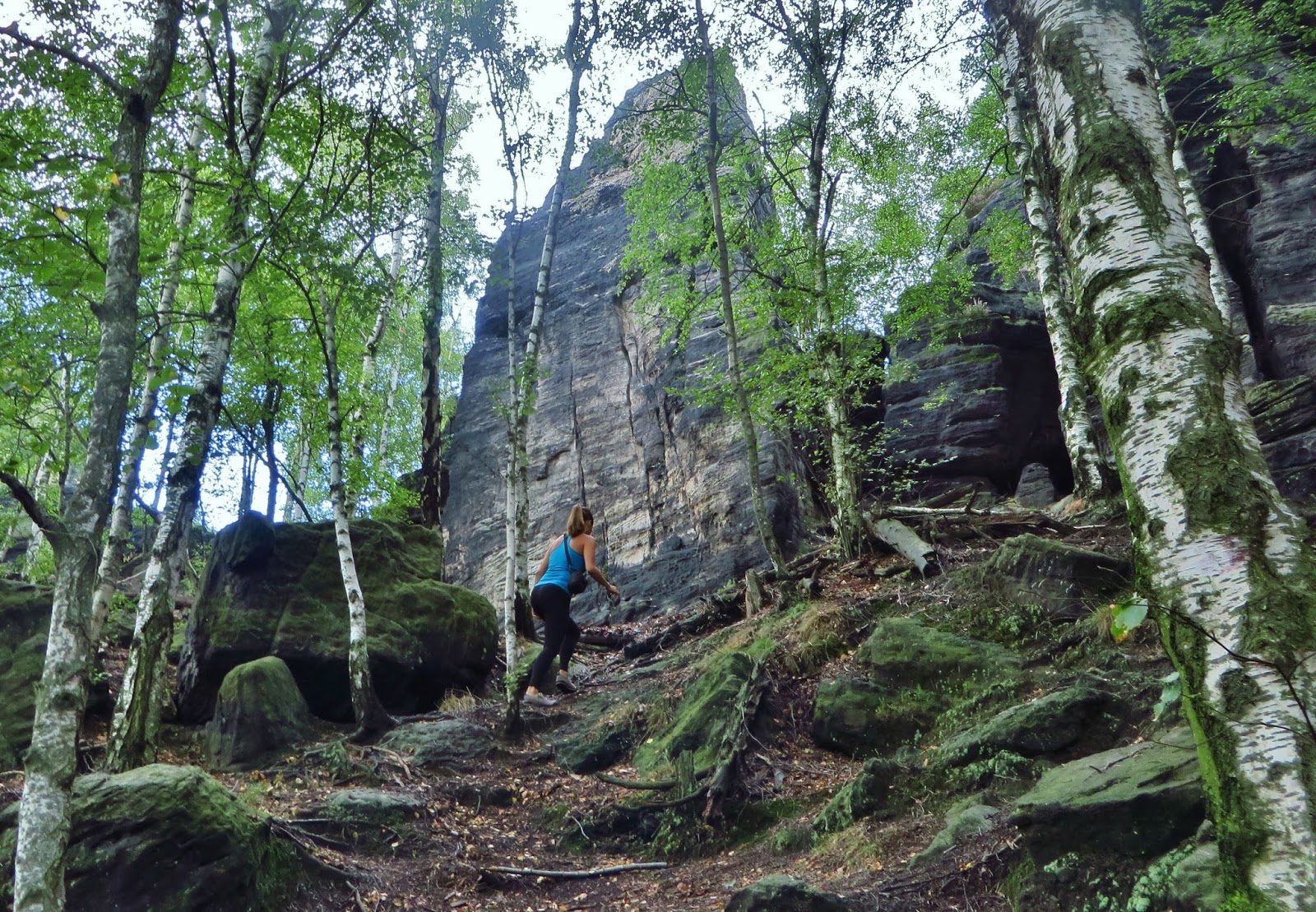
How Heather handled that whole stressful mess tells a lot about her. Vivid in my memory is one particular walk down to camp from the highlines. We were passing through dappled forest sunlight, skirting the base of cliffs whose tops we could only partially see through the trees—a scene worthy of a fairytale. Heather, walking in front of me, commented on how the trip wasn’t turning out at all how she had anticipated, and then she added, with heartfelt sincerity, ‘I really feel like I’m not here for me, like my purpose for being here is to be inspired by these other girls, by their achievements and growth.’

In spite of personal disappointment and added stresses, Heather focused on everyone else, on me, on the other girls.  She has a talent for celebrating others’ achievements.  I was especially grateful for that on this trip.  As odd as it may sound, I was so blindsided by the extraordinary success of my first highline walk that I almost failed to appreciate it.  Heather not only served as a mentor providing tips, reminders, and safety checks, she also jostled me out of my shock, applauded my victories, and let me know how impressive it was what I had done.  Have you ever had someone say incredibly nice things about you, and you desperately wish you had a tape recorder to capture the words so you could play it back to yourself when you’d had a rough day?  That is most definitely how I felt around Heather: wishing for a recording and wishing I could see myself through her eyes.


Photo by Noraxy Delgado
Heather pushed me to try new things, harder things than I thought I was capable of.  After I managed to “send” (successfully walk) the longline, she encouraged me to try the even longer highline, telling me I would be limiting myself to work on the intermediate highline instead of going straight to that most difficult highline.  It meant a lot that someone would believe in me that much—believe that there was a chance I could really walk a highline—only my second ever highline—that was three times longer than any line I’d walked on before that day.  I wish I’d had as much faith in my ability to conquer that line as she did.  Hopefully next time I’m on that kind of big line, with a little more faith, better remounting skills, and a few more tries, I’ll be able to accomplish the miraculous feats that Heather thought I was capable of.  I left the festival with the feeling that if someone I look up to as much as Heather thinks I’m inspiring, I must have more potential than I give myself credit for.

While my impressive first highline walk is something to be proud of, some of my favorite memories of the festival are actually of tromping up—or down—the hill to and from the highlines, with Heather ahead of me, both of us chatting the whole way.  We definitely had some good geek out conversations—Heather sharing her passion for rigging and rigging physics, me sharing my balance-life analogies, and for both of us all things slackline.  We got so caught up in our conversation once that we may have accidentally wandered into Germany before realizing we’d overshot our camp.


I’m grateful for the time I spent with Heather at the festival, for her ability and efforts to inspire those around her to reach their full potential, as she did so selflessly for me. So many of the greatest things in life are based on the experiences we share with others, and she has a gift for forging those moments of human connection. That is an incredible gift to have.