Sunday, November 29, 2015

A Clown at Heart


Getting in touch with your ‘inner clown’ is all about tearing that artifice away, about becoming open to failure and in the process also more open to yourself.”
~Duncan Wall, An Ordinary Acrobat


The thing I've learned about obsessions is that, like amorphous TV trope blob monsters, they can take any form or shape, they can be practically unstoppable, and they tend to grow, absorbing whatever they come across. My love of balance has similarly grown in scope, from slackline to balance pipe, tightwire, yoga, and ballet.  It's even grown beyond the balance sports, to include other circus disciplines. From manipulation I've taken up juggling, from acrobatics I aspire to learn cyr wheel, from the aerials I'd like to give silks or corde lisse a try.  The blob of my balance obsesssion hit a seemingly impenetrable barrier though at the last circus discipline: clowning.  I am not a performer, an actor, or comedian; I am reserved and inhibited, an introvert and often a homebody. Clowning was a discipline I felt I had no connection to.1

While reading Duncan Wall’s experience as a young American study abroad student attending a preparatory circus college in Paris, I was struck by his exploration of the art of clowning.  It changed how I look at clowning, and how I look at myself.  (My obsession may have just breached the final barrier!!)

Clowning is unique in the world of circus arts: rather than feats of athletic daring or dexterity, glitz or grandeur, clowns traffic in human emotion.2 But why are clowns funny? Why do we laugh over their bumbling failures? As Duncan Wall points out, “All our lives we are trained not to be vulnerable, not to expose ourselves, to avoid looking foolish.” Perhaps because of that training, seeing other people’s real-life failures can make us uncomfortable, make us want to look away. How do you react when someone has something stuck between their teeth, stumbles and mumbles through their speech, or wears mismatched shoes? It might be funny, but it can also make us uncomfortable feeling sorry for the person. But when a clown fails, flops, and looks foolish we laugh—and not in malicious superiority (speaking for myself at least!), but with humorous appreciation. What is the difference?

The line in the book that was my moment of illumination read, “A clown converts the tragic into the comic by showing the audience that he is aware of his failure and accepts it. This triggers empathy. [emphasis added]”  Reading that, the utterly revolutionary thought flashed across my mind: “I am a clown.” We do not have to be masters of cheesy costumes, exaggerated gestures and expressions, and over-bright makeup to participate in the soul of clowning.  In my own way, I participate in what is at the heart of clowning. It is something I already do: in the last few years especially I have learned to share my real-life failures and frustrations, openly, in ways that make people laugh.

Sometimes my clowning is because I want to cheer someone. Laughter is good medicine after all. Since I do try not to joke at other’s expense, I make myself fair game. I think my life is hilarious—or at least at times hilariously ironic or hilariously awkward. I share something personal—something a little absurd, a little surprising—to lighten the mood a little, to make people smile, to make people laugh.


At other times though, when my life has gone a bit awry, I clown because I do crave that empathy. Burying vulnerabilities and mistakes, carrying hidden burdens in stoic solitude is wearisome work. It is cathartic to open up. I portray my struggles and frustrations as a bit ridiculous, a bit absurd. A responsive, empathetic laugh soothes the sting of those failures. And in making someone else laugh, I have given them something even while I ask for understanding in return.

Practicing juggling and slackrope in public areas especially has further motivated me to embrace my inner clown. I fall, fail, and fumble a lot as I practice—generally while in view of more than enough passersby. Even though many don't pay any attention to my antics, the public visibility of my learning errors isn't easy for me. With the choice to withdraw inward in frustrated embarassment or to embrace the moment openly, my rule for myself is simple: "laugh when you fall." It's almost a reflex now.  I've lost count of the number of times I've ended up flat on my back in the grass, laughing at the rope wobbling loosely above me, and caught sight of a pedestrian chuckling sympathetically as they passed. Because my practices generally require undivided, unwavering attention, those brief laughing pauses after a fall are actually the best opportunities to connect, the time when people approach me, the time when I turn and focus outward for a little while. Regardless of whether I have an actual audience, with that laugh or dramatic smile, I release the mistake, leaving myself free to try again.

As I’ve learned to laugh off my mistakes, as I’ve seen others' laughing empathy, their uncritical acceptance of my fumbles and character flaws, I have indeed been liberated to accept myself and to appreciate the absurdities of the world and of my own life.

Laugh when you fall, smile when you fumble, be a clown.  It really does feel good.


1 Perhaps you are put off by “clowns.” To be honest, I was too: Some are almost frightening, others simply far too cliché…but then there are the good clowns, the ones who make us laugh, who make us a part of the show, the ones who let us enjoy the absurd. If you haven’t experienced good clowning, I have a few recommendations: first is the Cirque du Soleil movie Alegria (available on Amazon). The simple white-faced clowning of the main character Frack quite captured my heart. Next, it’s very hard to beat the dare-devil clown Bello Nock: http://www.youtube.com/watch?v=oWTezwTtfi8, http://www.youtube.com/watch?v=6mb6Di1Pe-0&list=TLjfSHy4BZJft_gAanFHmA9AbaczFge2gs .

2 Duncan Wall, An Ordinary Acrobat, pg 252.

Friday, November 13, 2015

Precious Moments, People Moments: Mr. Muddy Paws


Many of the brightest threads in my tapestry of memories are woven from the slender strands of human connection—simple yet precious moments of shared humanity: a genuine smile that tugs my lip into smiling in return, an inside joke that becomes increasingly hilarious only because we're both laughing, or simply recognizing in a stranger a kindred spirit.
~Me


Perhaps because of the cold autumn weather, I’ve been in a nostalgic mood, so I thought I’d share a favorite summer-time story. It's a favorite addition to my Precious Moment, People Puppy Moments series.


When I was first learning to slackline, one of my favorite spots was in the greenspace of my apartment complex. Just across a little stream in an open grassy area shared by my complex and a neighboring one, there were several lovely mature trees.  Other than the dog walkers, I pretty much had the space to myself.

I was in grad school; my survival strategy for the academic rigors of spring semester was taking my stacks of articles, plus snacks, water, a beach towel, and my slackline and setting up shop. Alternating between reading and balancing, I often stayed out until dusk, swaying and bouncing gently in time with the fireflies…until the mosquitos drove me in or it was too dark to see the line. Yes, these were the rare idyllic days of my rigorous graduate program.


On this particular day, I’d read till I thought my brain would burst and slacklined till my muscles weren’t holding balance anymore. I lay down on the lush spring grass, propped my feet up on the slackline, and enjoyed the warm sunshine on my face.

In my blissful doze, the sound of pounding of paws barely registered in time. I sat up with a jerk as an exuberant adolescent yellow lab reached me. He’d been playing in the stream nearby and must have noticed the lovely, low-to-the-ground, accessible human and had dashed over to say hello. I laughingly tried to fend off his overtures of friendship as he jumped around—and on—me with wet muddy paws.

His owners—an attractive couple in their mid to late 30s—rushed up to rescue me from their overgrown puppy. The wife was mortified and apologetic, the husband apologetic and amused.

Of the yellow laborador pictures available on the net, this 
guy best captures the essence of my mischievous friend.
Source: http://www.thelabradorsite.com/
With a tongue lolling grin, Mr. Muddy Paws eluded them, frisking just out of reach. He must have realized that his freedom was about to be curtailed and wanted one last hurrah, because suddenly he was off like a shot back to the creek bank. He remuddied his paws and dashed straight back to me. His owners apologies—and my helpless laughter—continued as he gleefully left a few more muddy paw prints on my white shirt and sky-blue scrubs before allowing himself to be caught.

The mud stains would never fully wash out of those clothes, but I could never see them without remembering warm sunshine, a grinning, mischievous puppy, and laughing till my stomach hurt.

Friday, October 30, 2015

The Walk


"Why?" That is the question that people ask me most. Pourquoi? Why? For what? Why do you walk on the wire? Why do you tempt fate? Why do you risk death? But I don’t think of it this way. …Instead I use the opposite word: life. For me, to walk on the wire, this is life. C'est la vie.
~Philippe Petit in The Walk


Take a deep breath. That was my thought as the vast spaces between and below the skyscrapers rolled across the theater screen the first time I attended The Walk. The cinematography, especially with 3D enhancement, was—literally—breathtaking.

Of course I'd already read and watched everything I could about Philippe Petit's walk between the Twin Towers of New York. This was my chance to glimpse the grandeur of those heights and depths, skies and abysses, as if I were there with Philippe on his wire. It was so well done that even from the safety of my seat I was fighting vertigo. As I imagined that it was me on the wire, I practiced the deep breathing of a highwire walker/highliner to steady my senses. As I pulled in a deep (audible) breath, I heard my friend Melissa, in perfect unison, suck in breath as well. Yes, the two of us were certainly wrapped up in the movie.

Photo: Sony Pictures

The Walk isn’t just a beautiful dramatization of a unique historical event, it is a glimpse into the world of highwire walkers and, most importantly, how incredible dreams are realized. There are plenty of talented movie critics who can tell you all about the movie and what makes it stellar cinematically, so I’ll just tell you what I took away from it, what I learned about dreaming.

To look at two massive, solid skyscrapers and dream only of conquering the intervening void, to actually rig a wire there, 1,350 feet from the ground, was probably insane, arguably irresponsible, and certainly illegal. It’s no wonder that the movie begins with the quote above, highlighting the question “why?” But according to the character of Philippe in that opening scene, there may not be an answer he can express in words for why he did what he did and dreamed what he dreamed. The best he can do is show us the how.

Even though, supposedly, this movie is only about how he pulled off his illegal walk, as you watch, you may find the why on your own along the way: if your heart turns over with as much joy as fear, then you know why, if you echo the many characters in the movie who simply called it “beautiful”, then you understand why. If it doesn’t…then your heart is tuned to different dreams and perhaps no explanation or justification for that question "why?" could ever convince you that Philippe Petit wasn’t just mad.

Often in this blog I try to explain why my heart is drawn to a dream similar to Philippe’s. It is something I will probably continue to do as long as I continue on this journey of seeking balance and continue writing about it. But I hope to take from this movie the truth that sometimes we cannot describe what drives us; then all we can do is focus on how we achieve our dreams.

Pulling off his walk between the Twin Towers, Philippe called “The Coup”.  Naturally then his friends and support crew became “accomplices”.  A coup is a victory—a brilliant, sudden, difficult, unexpected achievement. His walk certainly was all that. But as a former political science major, my mind wandered to the alternate, political definition of the word: an overturn or upset; an overthrow. I asked myself if that definition applied as well. But what was he overthrowing? His friend Jean-Louis had already claimed that all artists are to some degree anarchists, and the walk was certainly very illegal.

Photo: Sony Pictures
On the day of the walk, Philippe stood impishly defiant on his wire beyond the reach of police officers, the representatives of law and executive government, leaving them no (humane) avenues to enforce their commands that he come off the wire. Even as a law-abiding citizen myself, I can never quite bring myself to fully condemn Philippe’s coup—because it was more than just overthrowing the law. On that day, when he walked between the towers, he overturned the governing status quo: where we believe men can walk, what we as people believe is possible.

That is the second thing I want to remember: that impossible dreams aren’t out of reach, that with practice and passion I may wrest power from the despotic status quo. Elsewhere Philippe talks about the final, unseen accomplice to his coup, and offers advice on how to make him our accomplice as well: “The ‘impossible’ is not your enemy, he is your co-conspirator. …if you walk with him long enough, he is willing to let you in on a secret, to help you do something astonishing.”

The Walk was as breathtaking the third time as it was the first. Yes, I watched the movie twice more in theater 3D, each time with friends who, in the last few years, have become accomplices to my dream. Each time, from the darkness on either side of me, I heard satisfying quiet gasps and indrawn breaths. Each time I walked out of the theater fired with ambition, motivated to continue seeking balance, and feeling very much alive in those ambitions.


Oh, and I am incredibly jealous of lead actor Joseph Gordon-Levitt’s eight-day wire workshop with the real Philippe Petit.

Monday, October 12, 2015

Precious Moments, People Moments: Heather


Many of the brightest threads in my tapestry of memories are woven from the slender strands of human connection—simple yet precious moments of shared humanity: a genuine smile that tugs my lip into smiling in return, an inside joke that becomes increasingly hilarious only because we're both laughing, or simply recognizing in a stranger a kindred spirit.
~Me


The story of my adventures at the Girls Only Slackline Festival isn’t complete without writing about Heather Falenski. Usually the posts I write under this heading are about the occasional, fleeting moments of human connection, often about strangers whose names I may never know. In this case, however, I was blessed to have two and a half days full of moments, camaraderie, conversation, and friendship with a person I came to admire very much.

Prior to the festival, I didn’t know Heather personally. We connected a week or two before the festival when she wrote on the event page that she was looking for someone to travel with from Prague. Given the remote and somewhat difficult-to-find location of the event, having a travel buddy was a huge bonus. I responded. From that brief instant message conversation, I was convinced that I would really like this girl. I felt like things were finally falling into place for the trip. Heather seemed to feel the same way: she wrote, "I love how everything just works out when you're following your heart."

For Heather though, not everything would work out the way she’d anticipated or how she would have liked. Her trip to the Czech Republic was complicated by computer glitches, missed flights, and lost luggage—very lost luggage. When I arrived, more than a full day after she had, her checked bag containing gear and clothing was still completely, utterly, distressingly lost.

Heather is an experienced highline rigger—which is very, very cool. A complete highline rig, as well as her personal highline gear, were in that missing bag—which, to a rigger especially, is very, very uncool. Though the suitcase was eventually located, what Heather had imagined for the festival—rigging and walking her own highline—wouldn’t happen. Rather than wait by herself indefinitely in a hostel near the airport for news of her suitcase’s whereabouts, she decided to make the best of it and continue on to the festival, after first picking up a few replacement essentials, of course.

How Heather handled that whole stressful mess tells a lot about her. Vivid in my memory is one particular walk down to camp from the highlines. We were passing through dappled forest sunlight, skirting the base of cliffs whose tops we could only partially see through the trees—a scene worthy of a fairytale. Heather, walking in front of me, commented on how the trip wasn’t turning out at all how she had anticipated, and then she added, with heartfelt sincerity, ‘I really feel like I’m not here for me, like my purpose for being here is to be inspired by these other girls, by their achievements and growth.’

In spite of personal disappointment and added stresses, Heather focused on everyone else, on me, on the other girls.  She has a talent for celebrating others’ achievements.  I was especially grateful for that on this trip.  As odd as it may sound, I was so blindsided by the extraordinary success of my first highline walk that I almost failed to appreciate it.  Heather not only served as a mentor providing tips, reminders, and safety checks, she also jostled me out of my shock, applauded my victories, and let me know how impressive it was what I had done.  Have you ever had someone say incredibly nice things about you, and you desperately wish you had a tape recorder to capture the words so you could play it back to yourself when you’d had a rough day?  That is most definitely how I felt around Heather: wishing for a recording and wishing I could see myself through her eyes.


Photo by Noraxy Delgado
Heather pushed me to try new things, harder things than I thought I was capable of.  After I managed to “send” (successfully walk) the longline, she encouraged me to try the even longer highline, telling me I would be limiting myself to work on the intermediate highline instead of going straight to that most difficult highline.  It meant a lot that someone would believe in me that much—believe that there was a chance I could really walk a highline—only my second ever highline—that was three times longer than any line I’d walked on before that day.  I wish I’d had as much faith in my ability to conquer that line as she did.  Hopefully next time I’m on that kind of big line, with a little more faith, better remounting skills, and a few more tries, I’ll be able to accomplish the miraculous feats that Heather thought I was capable of.  I left the festival with the feeling that if someone I look up to as much as Heather thinks I’m inspiring, I must have more potential than I give myself credit for.

While my impressive first highline walk is something to be proud of, some of my favorite memories of the festival are actually of tromping up—or down—the hill to and from the highlines, with Heather ahead of me, both of us chatting the whole way.  We definitely had some good geek out conversations—Heather sharing her passion for rigging and rigging physics, me sharing my balance-life analogies, and for both of us all things slackline.  We got so caught up in our conversation once that we may have accidentally wandered into Germany before realizing we’d overshot our camp.


I’m grateful for the time I spent with Heather at the festival, for her ability and efforts to inspire those around her to reach their full potential, as she did so selflessly for me. So many of the greatest things in life are based on the experiences we share with others, and she has a gift for forging those moments of human connection. That is an incredible gift to have.

Friday, October 2, 2015

Time to Highline


Highlining took everything I thought I knew about fear and threw it into the sky. To stand on one inch webbing stretched across a void, with all exposure penetrating your vision and unhinging your brain, every iota of your being is telling you not to be there. This is fear and each step across that line pushes it slowly away.
~Faith Dickey


After four weeks and two teaser posts, my attempt to describe walking a highline is finally ready. It was a remarkable experience; maybe that is why it has been remarkably difficult to find words for it.

From my last post, you already know that I’d been dreaming of attending the Girls Only Highline Festival in the Czech Republic for several years. Choosing to go this year was a big, and somewhat scary, leap of faith. I’ve been practicing on the same basic gear—short ratchet kit slacklines—ever since I started slacklining over four years ago. The one exception was my first (and only) highlining exposure experience over a year ago—where I didn’t actually walk on a highline. I was traveling six thousand miles to highline…and I only had two full days at the festival. It absolutely felt right to go, but what could I possibly hope to accomplish in just two days?

I decided to keep it simple: aspire big in the long term, but have a defined “success” that was very attainable. In Moab I hadn’t found the courage to stand up on the highline, so that was my goal: to stand, even if it meant falling. I had done what I could to prepare with what I had. I assured myself that I was more ready this time to walk. But most of all I was determined to stand up, to take my first leash falls.

So on Friday afternoon, after a good night’s rest and watching the rigging of a long highline, it was time to head to a highline of my own.

A short hike brought me to a small group of girls sitting near one of the anchor points at the shortest highline, 18 meters, or about 59 feet. Conventional wisdom for highline success is to walk longlines close to the ground, then shorter, easier highlines where the mental (fear) factors of high balance come into play. That beginner highline was five feet longer than the waterline I’d trained on, and as long as anything I'd ever walked close to the ground. Since I’d never even been near a longline, my personal distance record might have been the shortest of anyone at the festival—not exactly a contest I wanted to win.

Enjoying the easy camaraderie in our little group, admiring the skill and persistence of the other girls, I felt remarkably calm…considering. I’d done a fairly good job of not thinking about the emotional and physical realities of highlining. I’d shoved my doubts down deep, bound them down tightly under outward stillness and unconcern. They were still there though, lurking beneath the surface, making me feel not quite in synch with my beautiful surroundings. The trees swaying in the cool autumn breezes, the bird’s eye view of our camp, the vast stretches of pinnacles lining the valley like sentinels couldn’t quite reach deep enough into my soul to soothe my disquiet. I wasn’t feeling very optimistic; I was worrying that I might fail at even my very minimal goal. Waiting for my turn on the line, I wasn’t even sure anymore that I wanted to try it.

At that point I knew I needed to get on the highline before any of that pessimistic gunk came churning to the surface. When the line was free, I hurried (carefully) to be next in line. Imagine how weird it was sitting at the edge of a cliff, feeling impelled to hurry tying myself to a rope, so I could scoot off the edge of a cliff. Impelled. I don’t have a better word for it. I was thinking that perhaps I ought to just find a new dream…while my fingers continued to tie the knot.

Tied to the leash, double checked by the more experienced highliners, I scooted out…and just sat there for a while, looking down in a hopeless attempt to get used to the yawning void below me, to the cliffs whose sheer walls plunged down to a bare rocky floor. As the distant ground below me seemed to waver, inviting me to join a dizzy dance with vertigo, from behind me the voice of my new friend Heather reminded me not to look down. She was right: I wouldn’t get used to it; looking down wouldn’t help me balance.

A deep breath, and I focused my gaze and my soul on the far anchor point, took another deep breath, rocked onto one leg, stood up...and walked straight across without falling once.

Photo by Miriam Mrrm
I wobbled, but was never dangerously out of control, never seriously afraid of falling. The focus of that walk was a beautiful thing: only the anchor point and the slackline that led to it mattered: down ceased to exist.

Even though, in the process of sitting to turn around, I lost my balance and caught the line, it counted as a perfect first walk, an “onsight,” a big deal in the world of climbing and slacklining.

Photo by Heather Falenski
I got back up (a process that was significantly more difficult than I remembered from last year), and with just as much steadiness crossed back. This time, as I approached the end, I managed to kneel, then sit, then lay down, a simple routine I’d done many times on the waterline. Perhaps that feeling of familiarity lulled me into complacency…or cockiness. Lying there, I let my focus wander; I wobbled, and rolled off. I’d taken my first (gentle) leash fall.

After an even more strenuous second leash climb and remount, I was back on solid ground, and was greeted with congratulations…which I’m afraid I didn’t accept as graciously as I would like. With adrenaline still coursing, but smothered by the lingering deep focus, and dazed by a success so incomprehensibly beyond anything I’d dared hope for, my brain fixated instead on how pumped my forearms and fingers were from the remounting. Yes, my reaction upon successfully walking my first highline—on my very first try!—was, “But my arms are sooo dead.”

Eventually the adrenaline wore off—leaving me with my stomach quaking and hands trembling—and elation finally crept in. Then for the next half an hour or more while we watched another slackliner work the highline, Heather and Miriam got to listen to me muttering, “I walked a highline…look my hands are still shaking” and other similarly eloquent ramblings.

After a lovely long rest and almost a whole pack of Haribo (Pico Bala) gummies, I recovered enough to walk again. I managed a clean walk to the far end, then kneeling, turning, and mounting smoothly. A few steps back toward the starting anchor, I fell hard and decided to be done for the day. A very good, wildly, unexpectedly successful first day.


My second and last full day was packed with firsts as well. On our way up to the highlines again, Heather and I stopped by the longling in the field by the campground. She convinced me to try it too—a fifty meter line, nearly triple my then personal distance record. Much to both our surprise, by my third try I walked that line too. My very first longline.

At that point, Heather suggested I challenge myself by going straight to the long highline, skipping the short and intermediate lines. Fifty-six meters this time, and significantly less tensioned than my first longline an hour earlier. After two remarkable victories, on that long line I finally had the experience that I had been expecting all along—a line so difficult it took all my willpower to force myself to stand up to take a fall. And fall I did: the line bucked me off a split second after I stood. But I did stand. Plenty sore from the day before, after that fall I called it a day. Though I have a nagging regret that I didn’t make more attempts and take more falls, I still feel proud of what I’d accomplished in that day, too.

As is my custom, I made time for one last memory moment, one last goodbye. Sunday morning, already dressed for church and in a hurry to get to services in a city far away, I couldn’t resist giving the longline one last try. In the soft light of early morning, and in a dress no less, I balanced for a few moments over dew-damp meadow grass. It seemed an appropriate way to say goodbye to Ostrov, the Autokemp, and the festival.


Wednesday, September 30, 2015

Girls Only Highline Festival VI


One thing I’m very passionate about is promoting and pushing other girls in this sport. So I’ve organized the Girls Only Slackline Festival every year in Czech Republic. …For me the coolest thing about Girls Only Slackline Festival is that the girls who come there are there because they love the sport. There’s no other reason to be there. They just want to highline. They want to try their hardest and accomplish something.
 ~Faith Dickey1


About two years ago I stumbled across a video on a blog. When I started watching, it was just another highline video. Basically really cooler-than-me people, doing really awesome things. I'd done no more than vaguely fantasize about highlining—it was far beyond my skill, gear, technical expertise, and community ties. I had no idea, no inkling, as I watched that the video would eventually take me a third of the way around the world and to actually highlining myself.

The video was from a Girl's Only Slackline Festival hosted by That Slackline Girl, Faith Dickey. It wasn't until after, as I read the video's description, that my brain wheels started turning: a festival—a place where strangers and novices might be welcome to tag along. In the Czech Republic—I love the Czech Republic. Suddenly the thing became a golden-cloaked dream and a concrete goal.

At the time, a trip to Europe was beyond my resources. Knowing though that such a thing as a slackline festival existed led me to search out the All Girls Slackline Festival in Moab last year, a wonderful experience and my introduction to highlining.

Wanting still to work highlining, I watched for other such opportunities. Unfortunately none of the festivals in the States that I knew about worked with my schedule. So when a promotion at work provided a boost in my resources, I decided to take my courage in hand, hop on a plane, go a third of the way around the world, and try out highlining in my favorite foreign country.

Like so many journeys, this one began in the dark of early morning. Thirty hours, 6,000 miles (9.700 kilometers), and two new friends later, I arrived at the festival site—thanks to the combined navigating efforts of those new friends—as dusk was turning to dark. It wouldn't be until the next morning that I saw and appreciated the beauty we were surrounded by.

The dark, however, made the warmth of a house and the greetings of the other girls that much brighter. That weekend thirty female slackliners, from a dozen countries, conversing in more than half a dozen languages participated in the sixth annual Girls Only Slackline Festival (GOSF), hosted by Faith Dickey.

Our base camp was Autokemp Pod Císařem, a campground resort with tent sites and a pub as well as small huts and houses and rooms. The name of the place means “The Campground under the Emperor.” Since it wasn’t situated at the base of an “emperor” mountain as far I could see, the name didn’t make much sense to me. That is until one night when I realized that I’d eaten my meals and used the WIFI in the pub sitting underneath a framed bust of Emperor Franz Joseph.

Besides hanging out at the pub, our group completely took over a large building on the outskirts of the camp, which, incredibly, had nearly enough beds for all of us. The Autokemp took very good care of us. And after sleeping overnight in a plane, that fully horizontal bed was a wonderful sight that first night.

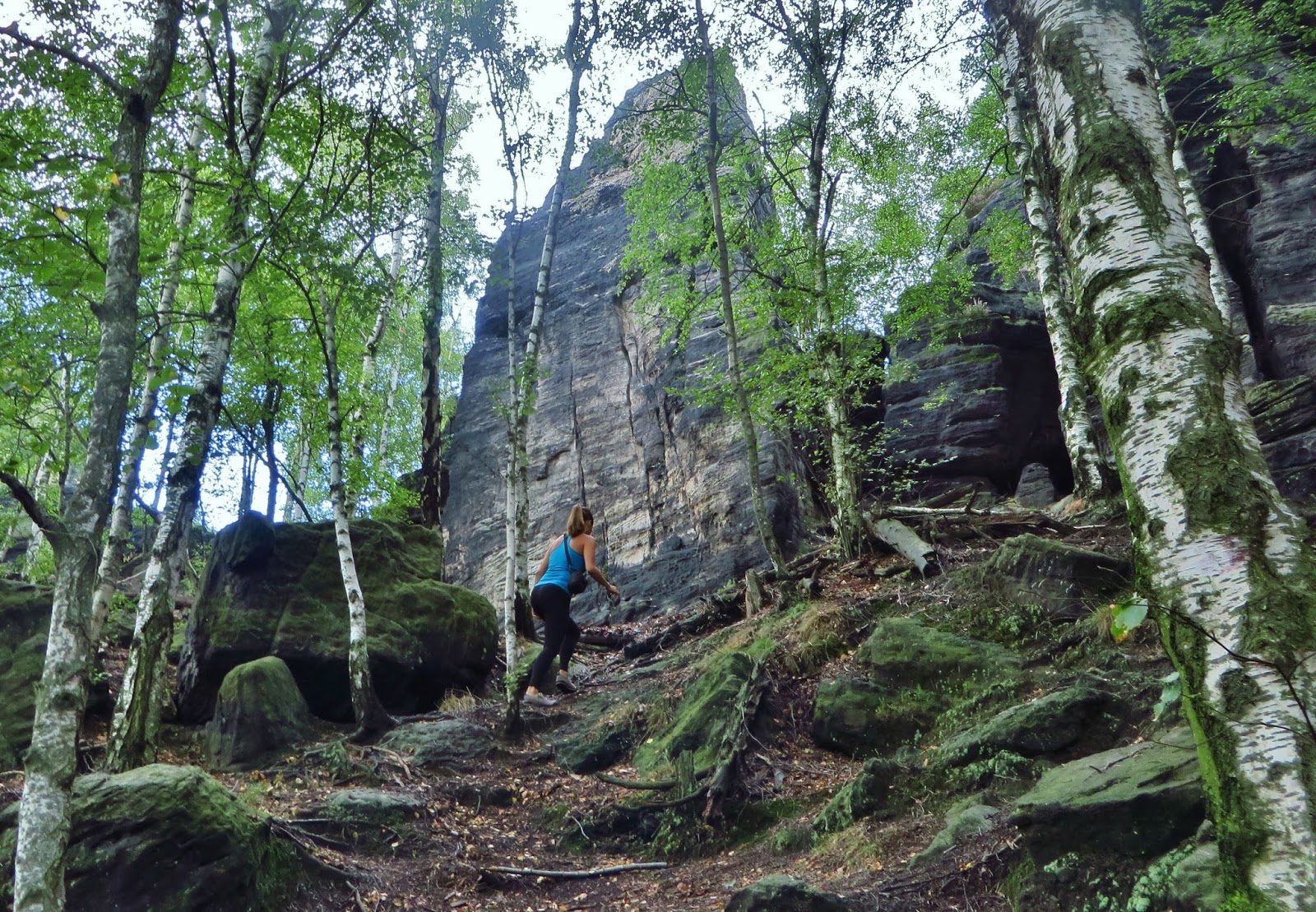
Daylight found me marveling in the verdant bowl of a U-shaped valley where the tiny settlement Ostrov and our campground are situated. Exposed cliffs and pinnacles rose out of the trees along both rims. It is terrain ready made for highlining, and much of it incredibly easy walking distance from our front door. The best one word description of the place I heard: magical. The rock formations, the forest definitely had the magic of fairytales, and also the magic of…possibilities, of real life dreams achieved.


The festival itself was fairly unstructured, except of course for Saturday night in the pub when we all gathered for group pictures and the passing out of swag—earned in a competition of bouldering the table (which attracted the interest of more than a few locals). During the day we split up, according to our interests, visiting the various highlines and the longline…and the pub for food and WIFI. Food, friends, fun, and a festival of slacklines…how could it not be an awesome experience?


Being surrounded by so many incredible women—who are also slackliners and highliners—was interesting, entertaining, even a little intimidating, and very much inspiring. Since I’ve been practicing on basic equipment, rubbing shoulders with experienced riggers was a treat; there is so much to learn. And now Faith, the event organizer, one of the best slackliners in the world, is someone I’ve actually met, not just someone I’ve seen in blog videos.


I had a fantastic time. So a big thanks to the Faith, Autokemp Pod Císařem, festival sponsors, riggers…and of course new friends.


Yes, yes I know you want to hear about my experience highlining (at least I assume you do). After struggling for weeks to find the words to describe my experience at the festival...I found I actually have a lot I want to put down in words. Several smaller posts rather than one gigantic one seemed like a good idea.

So, coming up next: my first highline!


Interview with Faith Dickey for the Girls Only Slackline Festival III. Video by kletterkiddie at https://vimeo.com/69651238.

Sunday, September 20, 2015

Summer Slackers Made a Splash


People take pictures of the Summer, just in case someone thought they had missed it, and to prove that it really existed.
~Ray Davies


Note: This post comes a bit late and out of order chronologically. In the midst of packing and preparing for my trip, twice my nearly finished draft of this post failed to save (it nearly didn't save again yesterday), and eventually I had to set it aside. Life is settling down now that I'm back, and I would feel remiss not to share, even out of order, at least something of nine waterlining sessions worth of memories, events, photos, and fun, so here goes...final draft take 3.5.

A lovely summer has flown by and another season of waterlining has ended. The chill nights and warm days of autumn make the mountain river water arctic rather than merely frigid. In the midst of the lovely cool, I'm also holding on to my warm summer memories. I most definitely have the pictures to prove they existed.

In terms of balance, conquering my first waterline last year was momentous. This year, by the end of nine waterlining sessions, getting across without getting wet was no longer a surprise; in fact as long as I stuck with a simple straight-across walk, I generally crossed without falling. I did make some progress minimizing how much I wobbled into starfish position and got plenty of practice doing Chongo mounts in preparation for highlining. Turns and tricks significantly increased the likelihood of falling, and so I pushed myself, even working to add another trick or two to my repertoire on this line...which made frequent dunking basically inevitable.

Ah yes, those frequent falls... My photographer friends, having thoroughly documented my steady, balanced moments, decided to capture those other, less than graceful moments. Yes, I will share:


In the end, after many, many delightfully awkward falls, I did come very close to doing “human origami”/“sideways buddah.” Getting back up without falling will be an accomplishment for next year.


While the small progresses in balance skill were rewarding, it was the people who made waterlining so memorable. First of all the friends who came so faithfully, some of whom have yet to experience regular slacklining (“grass-lining”?), and whose personal records are counted still in steps. The camaraderie they provided was priceless: we cheered each other on, laughed at ourselves, took turns lending a helping hand, and chatted while enjoying summer sunshine.

At our very last session for the summer, it finally occurred to me to bring a kayak for photographers to sit in rather than stand in the middle of the river for perspectives. (I have been forgiven for not thinking of it sooner, thankfully.) It was then that those dear friends had the hilarious idea of using the kayak paddle as a balance pole.  When mounting with a paddle in hand turned out to be too difficult, my friend Stacie volunteered to hand it to me once I'd mounted.  Impressively, by some serious double handed back splashing, my now paddle-less friend managed not to be swept under the slackline, and I managed not to fall into the kayak either.  Good times...though now we know that kayak paddles do not have the requisite weight or length to be effective balance aids.

There were also new friends: the strangers who stopped along the bridge to watch and even more those who stopped by to try themselves. Given the location of the line—a park and reservoir—we never lacked spectators and volunteers. In fact, for one family we became the entertainment not once but twice: one afternoon as I crossed the bridge to set up my line, I passed a woman who had been there the week before.  I had rather liked her on the previous occasion because she'd made an effort learn my name. She was on her phone, and as I passed I overheard her say, 'The girl, I told you about, [Guinevere], is here again. Hurry and come over and you’ll get a chance to try it too!' This reunion was for the other side of her family, who had jealously heard about the previous week's entertainment. Thanks to lucky timing, they would get their turn as well.

Last, but certainly not least, the kids. Yes, kids are kind of my favorite. On so many occasions throughout the summer the air resounded satisfyingly with laughter of fright and delight. Max, the son of one of my friends, at the end of his first waterline session turned pleading and glowingly enthusiastic eyes toward me and asked if he could have the waterline set up for his birthday. I’m quite sure I couldn’t have said no, but because of conflicting schedules we had to settle for the family’s Fourth of July picnic instead. Another little boy, Tristan, must have spent as much time at the reservoir with his family as I and my friends did: he found his way over to us at least three times. By the last time, he could bounce across the line sitting down in a matter of minutes. He was also confidently instructing first time visitors on the rules of the waterline.

Those are a few memories in words.  Now for the pictures—those beautiful pictures that prove that summer existed.


Yep, summer slackers made a splash, and it was spectacular. Here's to summer memories.